Showing posts with label space habitat. Show all posts

Saturday, June 8, 2019

Outfitting a Mined Asteroid Into a Luxury Solar System Shuttle


The early explorers set out on the high seas in wooden boats with cloth sails. They were brave people facing difficult conditions. The next century will see a similar wave of brave people willing to face difficulties to go see in space what no other human has seen or experienced. With proper planning, adequate funding, and modern technology, however, the conditions may not be all that difficult. In fact, they would definitely be considered luxurious by the crews of the NiƱa, Pinta, and Santa Maria. And it all has to do with an industry that doesn’t even exist yet—asteroid mining. 

Near Earth objects or NEOs are usually asteroids, sometimes comets, that come close to Earth at some point in their orbits around the Sun. These are some of the most likely candidates for extraterrestrial mining. There is no gravity penalty with asteroids like there is for Mars and the Moon so design, equipment, and fuel costs are much lower. Although the technology is almost up for it, there are a couple of things to be resolved before mining the asteroids becomes a real thing. 

A power source is required that won’t fizzle out towards the asteroid’s farthest point from Earth, which may be even further out than the asteroid belt. NASA could have a solution with technology called KRUSTY (Kilopower Reactor Using Sterling Technology) that puts out between 1 and 10 Kilowatts. I doubt that NASA is tired of the Simpsons jokes yet, so keep 'em coming. While most of the power needs of mining drones would be satisfied by a field of solar panels installed on the surface of the asteroid or hanging in orbit, it would not hurt to have a back-up generator should something go wrong. The drones will be powered by large lithium ion batteries like those in a Tesla and automatically seek a recharge near depletion like a Roomba. 


KRUSTY nuclear power plant - courtesy NASA


Also, someone needs to come up with an AI capable of running a space mission on its own. Once that's done and likely asteroid choices vetted, it won’t be long before AI driven, solar powered mining drones with a nuclear backup touch down on an asteroid as it makes a flyby of Earth and start mining it for water, metals, silicon, or whatever substance of value that can be hauled back to Earth orbit on the next closest pass. 

If the drones are careful about how they excavate this chunk of space rock, the owners will not only be making money from the mine, but by renting out a perfectly safe and comfortable Solar System shuttle as well. It will serve as a scientific expedition base as easily as a planetary system cruise ship or some combo thereof. 

What makes this craft so safe and comfortable? Besides the normal stuff like food, water, and air, there are two big current problems for human habitation of space—radiation and the lack of gravity. Radiation is a big bugaboo. Cosmic radiation can throw an iron nuclei at you that packs the power of a baseball thrown at 40 mph. Concentrating that much power in such a small area causes physical damage and ionizing radiation with mutagenic effects on human tissue. It could damage your eyesight and your genes. Also, we are not sure why, the lack of gravity in space is not that great for humans. It makes bones porous and muscles weak. It can also affect vision and balance. An asteroid-based shuttle does away with both of these problems. Here is how it will be done.

We will use asteroid 1996 FG3 as an example for this thought exercise. Asteroid 1996 FG3 has a diameter of 1.7 kilometers or 5,600 feet. It is a chondrite asteroid and rotates once every 3.6 hours and weighs more than a trillion pounds. It crosses Earth's orbit reaching just inside the orbit of Venus on its trip toward the Sun. Outward bound, it comes close to the orbit of Mars without crossing before heading back in. It takes 395 days to complete its journey so your trip will normally take at least a year. 

The mining robots will form a cylindrical shape from the interior of the asteroid as they remove material to be processed. The axis of this cylinder will coincide with the rotational axis of the asteroid. But there is a problem. Even if the internal cavity is quite large, say 3,400 feet in diameter, standing on the inside of that big cylindrical cavity the artificial gravity would be a paltry .002 standard Earth gravity at its current rate of rotation. However much it would help your dunk shot, it would not work to keep you healthy. 

If artificial gravity were to be created for cavities inside, the asteroid would have to be spun up to about 1.25 rpm or 20 times faster than what it is now. Even using the mass driver propulsion system I’ve proposed in A Heavy Metal, Cannibalistic, Asteroid Propulsion System producing 155,000 pounds of thrust, it would take a hundred years to get the asteroid up to speed. How can this be solved? 

We build a cylinder inside this cavity that is much lighter. With a cylinder spinning inside the asteroid, the gravity can be controlled by the speed of rotation. Assuming the dimensions already given, a cylinder 3,400 feet in diameter spinning at 1.25 rpm would provide .91 normal gravity. A 200 pound person would weigh 182 pounds if that person was standing on the outside wall of that cylinder. 

Such a large cylinder may have many levels from the center to the outer wall. If each level was a hundred feet from floor to ceiling, there would still be 17 levels. Gravity at the innermost level (100 feet from the center) would be .05 Earth normal while level 10 (1,000 feet from the center) would be .53 or half Earth normal. 

To save time and resources, the cylinder will be made a lot smaller and the rotation sped up to compensate. For instance, a 2,000 foot diameter cylinder spun at 1.65 rpm to provides .93 Earth gravity at the outermost level. But we’re not talking about enough room for a space colony … yet. We are only planning for a few dozen people. Plus, if the cylinder is over 100 feet long, serious structural issues begin to pop up at the outer level, the same ones that bedevil an engineer on Earth trying to span a 100 feet with proper safety margins. The above design can be pared down to its simplest configuration—a glorified centrifuge. 

This centrifuge would consist of two arms of equal length attached to a central hub. The arms would serve as the vertical access tube to the different elevations and as the main structural support countering centrifugal forces. 


Drawing by Glen Hendrix. Click to enlarge.


This first illustration shows a minimalist layout for the habitat inside the asteroid. The hub of the habitat contains electromagnetic bearings that provide frictionless rotation of the habitat. The illustration shows six levels but that could vary. Whatever the final configuration, the arms have to be identical and the internal loading must be monitored by AI to prevent unbalanced loads. 

The long, curved outer tubes on the arms will be considered the “basements” as they are the farthest thing “down” and they have the highest gravity at .93 g, a little less than Earth normal. The next level “up” would be .79 g and the next, .65 g. The short tubes closest to the center will be the “attics”. They only have an artificial gravity of .23 g, less than 1/4 of Earth’s gravity. The basement and the next level up will be the primary levels for residence since this will convey the greatest protection against the deleterious effects of low gravity. The rest will serve as labs, storage, and special applications. 


Drawing by Glen Hendrix. Click to enlarge.


1996 FG3 is a chondrite asteroid made up of anhydrous silicates, hydrated clays, organic polymers, magnetites, sulfides, and maybe some nucleic and amino acids. The Murchison meteorite proved the extent of organic materials in space when 70 different amino acids  were found using high resolution spectroscopic tools. There is the possibility of millions of unique organic compounds in that same meteorite. It is possible these will also show up in asteroids like 1996 FG2. 

The asteroid has water, which is important. Water will be extracted during the mining process and stored as ice.  This water will power the rotation of this habitable centrifuge. Rocket motors burning hydrogen and oxygen will bring the habitat up to speed with occasional boosts to keep it there. The hydrogen and oxygen come from water mined from the asteroid. This will be the only instance where rocket exhaust in space can be reclaimed and reused. The rocket exhaust will turn to water which will turn to ice which will accumulate in the inner cavity housing the habitat. Special drones will vacuum the ice crystals up periodically for recycling.


Drawing by Glen Hendrix. Click to enlarge.


Once the habitat is up to speed, it’s time for the voyagers to move in. A deep space tug has brought them from Earth’s orbit to 1996 FG3 as it makes one of its passes near to Earth. The tug parks in a bay excavated for it by the mining drones. This gives it protection from radiation coming from most directions. The illustration labeled “Detail 3” shows the tug in its protective bay. The space-suited future inhabitants go from the tug to the access tunnel dug into the rock of the asteroid. This leads to the airlock for the habitat. Through this they gain entry to pressurized living space and transition from 3.6 rotations per hour of the asteroid to the 1.65 rotations per minute of the habitat. They shed their suits, and climb “down” one arm or the other to different levels. 


Drawing by Glen Hendrix. Click to enlarge.


As illustrated, this habitat has about 320,000 square feet of habitable space. That does not include areas for storage or utilities. If just half is used for 600 to 1200 square feet apartments, a hundred to two hundred people could have their own digs aboard this asteroid shuttle. 


Drawing by Glen Hendrix. Click to enlarge. 

This design easily lends itself to expansion. From the minimal wedges of the original layout, it goes full circular. Also, the mining drones have excavated four more cavities for additional rotating habitats and added another access tunnel with docking bay at the other end of the asteroid. This space would allow about 26,000 people to inhabit the shuttle. 

By this time, and we may be talking about a couple of centuries in the future, there is a mature economic system in space. There will still be a few tourists, but much of the habitat will be devoted to labs and manufacturing facilities making products in low gravity or vacuum that can't be made on Earth. There will be labs studying new organic compounds discovered on asteroids and comets. It could include a new repository of seeds that will replace the Svalbard Global Seed Vault in Norway. It will be safer from cosmic radiation and/or conflict and climate change on Earth. Likewise, a repository of the world's animals as embryos will come about and be stored on such an asteroid. 

On its approach to Mars, it will become commonplace for one of the deep space tugs to rendezvous with the uppermost station of the Mars Space Elevator, allowing people to go to the surface of Mars to conduct business or science or just sightsee. Likewise, the approach to Venus allows travelers to make a connection with the orbital labs around Venus working to terraform the planet. 

Other asteroids will be converted in a similar matter. Some will have orbits taking travelers to the outer edges of the asteroid belt, almost to Jupiter. These shuttles will be excellent for launching expeditions to the outer planets and their moons, the Kuiper Belt, and even the Oort Cloud. Outposts with fuel and supplies for these ventures can be more easily stocked with such a conveyance. 

The human race is at this fantastical pivot point in history. At the same instant in time, historically speaking, we are poised to begin an expansion into space and to witness our planet ravaged by unforeseen (or ignored) circumstances involving the very industrial/technology base that allows us to venture into the great unknown. I sincerely hope we are up to the precarious balancing act from here forward that will allow us to keep our home planet livable while exploring others. 


Other articles you may enjoy:


Carbon Capture and Sequestration (CCS): The Existential Technology We Are Ignoring


There May Be a Quadrillion Dollars Lying About on the Moon

Mining That First Asteroid - Manned Mission or AI?

A Convergence of Technologies Will Create a New Age of Space Exploration


The Space Habitat Revisited and Revised


Monday, December 17, 2018

Steampunk Meets Star Wars: A Harrowing Micro-Tale of Future Spacefarers


Photo by Taton MoĆÆse on Unsplash


The year is 2107 and mankind has begun to mine the asteroids. A small habitat houses 10,000 people that live and work in space, have families, and raise kids. 

Solar cells and fabricated panels are still made on Earth and are highly prized in space. The only supplier of solar panels (who paid Earth-based governments for the monopoly) to the coterie of companies in space keeps raising prices, and the orbiting crowd is  tired of it. They boycott the solar panels. There are, however, pressing energy requirements for ongoing projects in orbit. Are they screwed? Is there an alternative? 

Assuming there is no nuclear fusion technology (at that point in the future, it is only 30 years away) there is still an alternative. Steam power. Don’t laugh. Disclaimer: This is not a steampunk story. Okay, maybe a little since it’s in the title.


Steam may be the most cost-efficient way to power a space habitat. Outer space is perfect for producing steam. Producing photovoltaic  or solar cells is pretty sophisticated fabrication requiring specialized equipment and a particular type of silicon. Not saying it can’t be done in outer space but think how much easier it would be to use steam. 

Steampunk Modernism

Photo by Scott Webb on Unsplash


It would, basically, be a metal coil in sunlight producing steam that’s sent to the turbine, comes out of the turbine and goes to a condensing coil shaded from the Sun. The steam turns back into water, and the process starts again. The turbine would be located all snug in the habitat spinning its generator while the coils are out in space. A steam power utility station could also be built as a stand alone unit to be towed to wherever electric power is needed in space. 

This is, essentially, how the ISS maintains its inner temperature. A water coil in the ISS soaks up heat, then goes outside to a shaded coil that radiates the heat into space. When the space station is in sunlight, things on the outside can heat up to 250 degrees F, while in Earth’s shadow it can get down to -250 degrees F. These extreme temperatures can affect the inhabitants, despite very good insulation. This is why some system for temperature stability is needed. 

A large steam turbine is about 50% efficient while a photovoltaic cell is currently about 20% efficient, although that’s a bit moot considering how much solar energy is available in space. But what about the turbine itself? If solar cells can’t be made, why would a steam turbine be any different? By this time, 3D printing in space will be a given. Masonry type items made from powdered asteroid, plastics made from methane ice, and asteroid metal ranging from mild steel to high-temperature stuff like inconel will be just some of the things that can be printed out. Many parts of the habitat itself will have been 3D printed. The design for the turbine could be uploaded from a number of companies on Earth willing to make money on blueprints they have had laying around for over a hundred years. 

Also, by this time there should be plenty of water mined from asteroids to use for such a project. Unless there is a catastrophic leak or break in the system, the water can be used over and over forever. To get the steam temperature up to useful working pressures, a few hundred pounds per square inch, mirrors would be required to multiply the radiation striking the coils. Also, some insulation and heat tracing may be necessary for the condensing coil to keep from freezing up. Here is a schematic of how such a system might work. 


Click image to enlarge. Drawing by Glen Hendrix.


So there it is. Once again the forces of good and human ingenuity have conquered evil, greedy bastards out to make a fortune off of someone else’s tight situation. If it were only always that easy. 

Postscript: 

Apparently I'm not the only one thinking about this.

Researchers develop a steam-powered spacecraft that can hop between asteroids


Other articles you may enjoy:


The Space Habitat Revisited and Revised


Wednesday, December 5, 2018

The Space Habitat Revisited and Revised


Courtesy NASA


In the summer of 1975, forty-three years ago, NASA and the American Society for Engineering Education sponsored a design study for space settlements. The technical director was no less than Gerard K. O’Neill, the famed physicist who studied and publicized what could be done with large space habitats. This NASA study laid out the fundamental design criteria; size, shape, material, etc.; that would be optimal for a space-based settlement. Based on the physical laws of the universe and strength of materials, much of this information is still valid, but a lot has happened since then. This get-together came about two years after Arthur C. Clarke published “Rendezvous With Rama” (see 3D tour), the story of a 30 mile diameter habitat from an alien race that enters the Solar System. 


On this eve of great changes; with AI sages claiming the singularity is right around the corner, and climate scientists saying doom is nigh; we should take another look at how we might design and build comfortable habitats for a large population beyond the surly bonds of Earth.

We have more tools in the box than in 1975. Science and engineering have made great strides - 3D metal printing, graphene, mass-produced carbon fiber, carbon nanotubes, and artificial intelligence are but a few. Due to gravity, centripetal forces, geometry, and material strengths the NASA study came up with some basic shapes that one could use to build such a structure. This drawing shows those geometries while the next portrays a universal element that could be repeated to obtain these shapes.


Courtesy NASA

Courtesy NASA


The Stanford torus is one of the designs that came out of that 1975 study and uses one of the basic shapes. It is NASA in origin but takes the name from Stanford University, the site of the design exercise. One point eight kilometers in diameter, it rotates at one rpm to maintain a one g artificial gravity.


Courtesy Wikipedia

Courtesy Wikipedia

Here is the lunar mass driver proposed to deliver the 10 million tons of material required for the Stanford torus to be constructed at a nearby Lagrange point.

Courtesy Wikipedia

An interesting combination of these shapes is the Bernal sphere. This was first conceived of by John Desmond Bernal in 1929. It combines the torus and sphere into a workable habitat where the heavily shielded sphere is where people work, and the torus bands are for agriculture. This design was later modified by O’Neill to form Island One and Island Two. Island Two is depicted in the pictures below. 

Bernal sphere - courtesy Wikipedia


Inside the Bernal sphere - courtesy Wikipedia

Toroid sections of Bernal sphere - courtesy Wikipedia

One major flaw in most of these designs from decades ago is the transparent sections left in the structure to allow sunlight to be reflected in by mirrors. Even though the glass or plastic will be thick enough to take structural loads from interior air pressure, it will not be effective at blocking cosmic radiation, the bugaboo of outer space. Cosmic rays can come from any direction with no warning. That’s why consideration of giving the agricultural sections less shielding to cut costs is another no-no. The living quarters of a space habitat have to be shielded from this radiation at all times. Sunlight will have to be ducted in through light tubes, or solar panels will power up thousands, maybe millions, of LED lights running through the center of the habitat to simulate sunlight. 


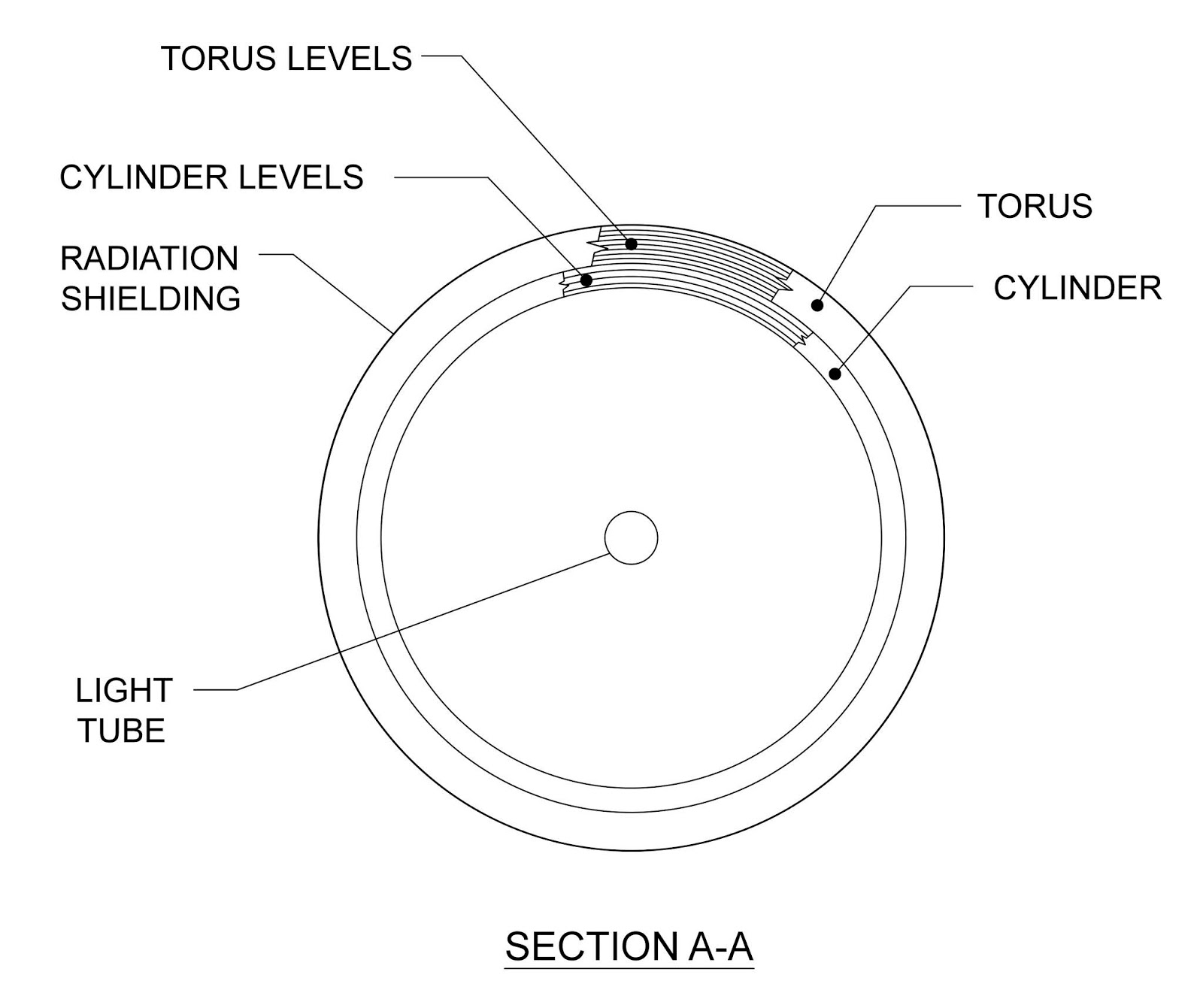
Using the study’s conclusions about optimal shapes and sizes, there is a variation that would be advantageous structurally and aesthetically. More bang for the buck could be had by using the torus geometry in the multiple side-by-side configuration to form a cylindrical habitat. The tori would essentially serve as the structure for the cylinder, eliminating a lot of material while providing about twice the living space (at approximately one g) of the habitat alone. The following drawings graphically describe this configuration. Click on them to expand the view.


This configuration will have living, work, and recreation space for between 2 and 3 million people, including about 3/4 billion cubic feet of storage. It is 1.3 miles in diameter and 3.2 miles long. Method of construction will be 3D printed molds to be filled with a slurry of powdered asteroid or Moon regolith, water, binder, and strands of carbon nanotubes. The parts will then be deposited in giant plastic bags to recover the water vapor while they dry. When the parts are cured, they will be assembled by manned construction vehicles and unmanned drones resembling rocket-powered octopi. 

Timeline: about 50 years hence. This will be when the first asteroid has been captured, corralled, and mined out. Realizing the unlimited future in space, the great flush of wealth produced will be used by the asteroid mining companies to fund projects similar to this habitat. 

The alternative to this design is to take a mined-out asteroid and turn it into a habitat. Students and researchers at Delft University of Technology are currently working on turning a hollowed out asteroid into a vessel capable of traveling to other star systems - an even more ambitious project than that proposed here. 

As we use up more resources, require more energy on our planet, and the climate becomes more hostile, we will look more often to the skies as a solution. It may get bad enough to view such habitats as preserves to maintain plants and animals that could be lost forever if left on Earth. In some ways, such a habitat may be safer and more comfortable than on Earth. There is no denying that once we escape the gravity well of Earth, the possibilities in space will seem endless as space itself. 


Other articles you may enjoy:


Tuesday, September 4, 2018

Workers In Space Will Live In Igloos


Courtesy Kordite at flickr


The mining of asteroids will begin in earnest within the next 10 to 100 years. The asteroids chosen for retrieval and processing will almost certainly contain water because water will be one of the most valuable commodities in space, if not the most valuable. Not only does water contain hydrogen and oxygen for rocket fuel, humans need it for survival; and it is very efficient at stopping many types of radiation. 

If a current or future corporation is going to make a decision on which asteroid to go after, the metal content of the asteroid may not be the deciding factor. Asteroids with little or no water will be passed up for mining at least in the early phase of the industry. If our civilization remains technically and economically viable into the 22nd century, the asteroid mining industry should be hitting its stride and keeping economic growth positive for several hundred years. Even after this maturation, the industry will favor those space rocks containing water simply out of habit and tradition unless some special material is needed that can’t be found in combination with water. Another outlier would be a leap in engine technology, such as a compact fusion drive, that would mediate the reliance on water as stored rocket fuel.


Use those plastic grocery bags again. Save money. Save the world. Here’s how. 


Let’s say some future company is evaluating two different asteroids for mining. One, 1999 JM8, is a nickel, cobalt, and iron asteroid worth $45 trillion dollars. It is fairly large at 4.35 miles in diameter, but only .024 Astronomical Units away at its closest approach to Earth, approximately 2.2 million miles or about ten times the distance from the Earth to the Moon.

Another asteroid, 1950 KA, is worth only $33.4 trillion dollars and is .097 AU at its closest pass to Earth, nearly four times that of 1999 JM8. It has a couple of things going for it, though. It is only 2.17 miles in diameter and has a composition of nickel, iron, cobalt, water, nitrogen, hydrogen, and ammonia. 

This company will pick 1950 KA because of the water, hands down. Once the robotic retrieval craft gets to 1950 KA, it can mine water; and, with the abundant solar energy available in space, split it into hydrogen and oxygen for rocket fuel to move that mass back to Earth.

Courtesy NASA


After 1950 KA is parked in orbit near Earth in one of the Lagrange points L4 or L5, the real fun begins. Using many specially designed, semi-autonomous robots, the asteroid is scraped, tunneled, bored, melted, smelted, hammered, drilled and crushed to extract its treasures. In the early going of asteroid mining, however, it will not be done without humans. We will be there to direct the overall strategy and change tactics when necessary, not to mention repairs and hands-on inspections. This is only because artificial intelligence will not yet be up to the autonomous decision making required of mining asteroids. 


Plastic grocery bags prefer this as their second career. 


Human workers need a safe, even comfortable place to stay while performing these chores. Safe by logical necessity and comfortable to attract the type of person needed for this work given how long they will have to be in space. Money can only go so far as an incentive. Intelligent, athletic, engineering and scientific types only need apply, similar to astronauts in education and ability. 

Here is where the water comes in. These people will be shielded from radiation by a wall of water, actually ice. As I mentioned above, water is very efficient at shielding many types of radiation, including that from solar flares, gamma radiation, and cosmic radiation. Although NASA has been working on a lightweight polyethylene plastic called RFX1, it has some serious problems in competing with water. One, you can’t drink it. Two, it has to be hauled up the gravity well of Earth. 

Exactly how will water be used as a radiation shield? Three feet of water or ice will intercept and diffuse almost any radiation, including gamma rays and cosmic rays. Since there is plenty of water available from the asteroid, it makes sense to protect the entire facility instead of providing a vault or other safe area that people have to go to. At some point, an unexpected sleet of radiation is bound to sweep through the area. This way everyone will be protected all the time unless they are doing something outside of the habitat and not working inside the asteroid.

The geometry of the habitat will resemble a thick hockey puck. This will rotate to provide simulated gravity to the inhabitants. On the unit shown in the drawings, eight rotations per minuted will provide nearly one g at the outer wall or "lower" level. The second level will provide three quarter g, and the "upper" level one half g. The center on one side will have a docking facility. The center of the other side will sprout a boom about as long as twice the diameter of the pancake. At the end of this boom will be thrusters that can point in almost any direction. These thrusters will be powered by, you guessed it, electrolysed water in the form of hydrogen and oxygen burning to form, once again, water.

CLICK TO ENLARGE


Not only is it a habitat, but it can move around as required to view different parts of the asteroid or move equipment that is not self-motile. It will pick up and drop off people at the orbital end of the Lunar Space Elevator. It will be a habitat, taxi, and tug. Some may call it the "Ice Palace", but it’s a given the majority will nickname it the "Igloo."

CLICK TO ENLARGE


This three foot barrier of water will remain frozen because space is cold. Solar energy hitting the outside envelope of the vessel may have some effect, but as that surface rotates into shadow, it will become frozen again. The inside surface of the ice barrier will be in a constant state of melting. The human habitation will necessarily give off heat. No matter how thick the insulation, it will eventually melt this inner surface. This water, through centripetal forces will be routed to the outer surface where it will be refrozen. This ice barrier is a good buffer between the 70-75 degrees Fahrenheit in the habitat and the minus 450 degrees F. of outer space and will probably vary in temperature, getting colder from the inner to outer surfaces.

The lure of infinite wealth and energy will be too strong for capital to resist. A lot of money will be spent on this endeavor. Hopefully, it will be spent wisely, and progress will be swift and beneficial not only for those companies involved but for the rest of us as well. The bottleneck is the gravity well barrier that is currently so expensive to vault. Space is kind of like Vegas; what happens there stays there. However, companies like Obayashi Corporation are working on building an elevator to space. This would drastically reduce the cost of sending stuff into orbit and bringing it back. Their plan is to have it built by 2050, waiting only for the successful mass production of carbon nanotube fibers long enough to use. Hopefully, their prediction will not become similar to the refrain of nuclear fusion developers of having a practical fusion generator within thirty years … every year. While the industry can have some success with rockets, it will grow by leaps and bounds with a working space elevator.

Other articles you may enjoy: