Showing posts with label asteroid. Show all posts

Sunday, December 23, 2018

A Convergence of Technologies Will Create a New Age of Space Exploration


Small satellites.


A convergence of AI, micro-miniaturization, 3D printing, relatively inexpensive space launches, and thruster-on-a-chip technology will herald a new age of space exploration by corporations and governments alike. 

Think about all the things your smart phone can do. Now imagine a smart phone without a screen. All those thousands of emails are not clogging the system. The dozens of apps are gone, including the ones you actually use. Instead, there is a resident AI that sifts through all the sensors and comms, constantly evaluating status of the mission; whether to shut down and coast, make course corrections, or send in a status report to a remote user interface.  It is the captain of a twenty pound drone headed to an asteroid to check it out for precious metals, water, and other valuables. 


Micro-electro-mechanical system (MEMS) sensors and manipulators will augment the electronic circuits and software on this drone. MEMS gyroscopes and accelerometers power tiny GPS systems for cars and missiles. MEMS piezoelectronics allow inkjet printers to work properly. MEMS microphones populate mobile phones and autos. Silicon MEMS pressure sensors tell us the pressure in our tires and our bodies. There are tiny fluid pumps, ultrasound transducers, and scanners. Soon, all of these devices will become nano-electro-mechanical systems (NEMS), much smaller and requiring less energy. These devices will be incorporated into this new wave of robotic space drones along with new applications such as drilling into asteroids, ore assayer, and atmospheric analyzers. 


MEMS rheostat, about 500 microns in diameter.


Rocket Lab is turning satellite launching on its head by making smaller rockets that can launch more often and cheaper. It uses 3D printing to print out its rocket motors. It can print out one every 24 hours. It uses composite materials and electric fuel pumps to make the Electron rocket lean and efficient. The goal is to launch a 150 - 225 kg payload into space weekly. Soon, it will be carrying small, autonomous space vehicles to explore for asteroid treasure and do scientific surveys of planets and moons.


Electron rocket from Rocket Lab.


Once in orbit, these autonomous drones will need motive power to accomplish their missions, and this is where Accion Systems’ thruster-on-a-chip technology takes over. This is a new type of ion energy drive using an electrospray process to accelerate ions out of a specialized computer chip, creating thrust. It will do this as long as it has the ionic liquid propellant it needs; a non-toxic, non-flammable salt solution. It currently has a thrust density of 0.4 Newtons per meter squared with a theoretical limit of 10,000 Newtons per meter squared. 


Thruster chip from Accion Systems. 


With eight planets, 172 moons, a 150 million asteroids in the asteroid belt, 100 million icy objects in the Kuiper Belt, and an estimated one to ten trillion objects in the Oort Cloud, there are a lot of things in our Solar System to be investigated. Many of these things will have to wait on a small, long-lasting nuclear power systems to get to them, but nuclear fusion is only 30 years away (as it has been for the last 70 years). 

Asteroid mining will become to corporations what the California and Klondike gold rushes were to individuals. Dire news about peak this and peak that competing with stories of weather gone crazy and new warm temperature records every day will be further goads to looking off planet for energy and material resources. Some corporation will soon realize that a new gold rush is upon us. 


That corporation, which may currently be someone sitting around reading an online article right now, will begin making robot drones like Apple makes iPhones. You can buy a basic drone and then get accessories like location beacons to leave on asteroids, software to make a run at skimming the atmosphere of some large moon, storage for the return of ore samples, a small shielded capsule for Earth re-entry, or any number of useful and expensive iterations. 

It’s not something that can be done on the back of a napkin - maybe lots of napkins - but, given the progression of technology, major parts of it could be off-the-shelf. Currently, the largest piece of the puzzle is the AI software to carry out the mission from Earth orbit to, say, the asteroid Ryugu, take samples, and make it back.

The target product is a 20 pound drone that can go 50 million miles somewhere in space, do a survey, and come back. The Electron rocket is ready to take five at a time every week to their rendezvous with destiny. Need a napkin?

Other articles you may enjoy:


The Space Habitat Revisited and Revised


Wednesday, December 5, 2018

The Space Habitat Revisited and Revised


Courtesy NASA


In the summer of 1975, forty-three years ago, NASA and the American Society for Engineering Education sponsored a design study for space settlements. The technical director was no less than Gerard K. O’Neill, the famed physicist who studied and publicized what could be done with large space habitats. This NASA study laid out the fundamental design criteria; size, shape, material, etc.; that would be optimal for a space-based settlement. Based on the physical laws of the universe and strength of materials, much of this information is still valid, but a lot has happened since then. This get-together came about two years after Arthur C. Clarke published “Rendezvous With Rama(see 3D tour), the story of a 30 mile diameter habitat from an alien race that enters the Solar System. 


On this eve of great changes; with AI sages claiming the singularity is right around the corner, and climate scientists saying doom is nigh; we should take another look at how we might design and build comfortable habitats for a large population beyond the surly bonds of Earth.

We have more tools in the box than in 1975. Science and engineering have made great strides - 3D metal printing, graphene, mass-produced carbon fiber, carbon nanotubes, and artificial intelligence are but a few. Due to gravity, centripetal forces, geometry, and material strengths the NASA study came up with some basic shapes that one could use to build such a structure. This drawing shows those geometries while the next portrays a universal element that could be repeated to obtain these shapes.


Courtesy NASA

Courtesy NASA


The Stanford torus is one of the designs that came out of that 1975 study and uses one of the basic shapes. It is NASA in origin but takes the name from Stanford University, the site of the design exercise. One point eight kilometers in diameter, it rotates at one rpm to maintain a one g artificial gravity.


Courtesy Wikipedia

Courtesy Wikipedia

Here is the lunar mass driver proposed to deliver the 10 million tons of material required for the Stanford torus to be constructed at a nearby Lagrange point.

Courtesy Wikipedia

An interesting combination of these shapes is the Bernal sphere. This was first conceived of by John Desmond Bernal in 1929. It combines the torus and sphere into a workable habitat where the heavily shielded sphere is where people work, and the torus bands are for agriculture. This design was later modified by O’Neill to form Island One and Island Two. Island Two is depicted in the pictures below. 

Bernal sphere - courtesy Wikipedia


Inside the Bernal sphere - courtesy Wikipedia

Toroid sections of Bernal sphere - courtesy Wikipedia

One major flaw in most of these designs from decades ago is the transparent sections left in the structure to allow sunlight to be reflected in by mirrors. Even though the glass or plastic will be thick enough to take structural loads from interior air pressure, it will not be effective at blocking cosmic radiation, the bugaboo of outer space. Cosmic rays can come from any direction with no warning. That’s why consideration of giving the agricultural sections less shielding to cut costs is another no-no. The living quarters of a space habitat have to be shielded from this radiation at all times. Sunlight will have to be ducted in through light tubes, or solar panels will power up thousands, maybe millions, of LED lights running through the center of the habitat to simulate sunlight. 


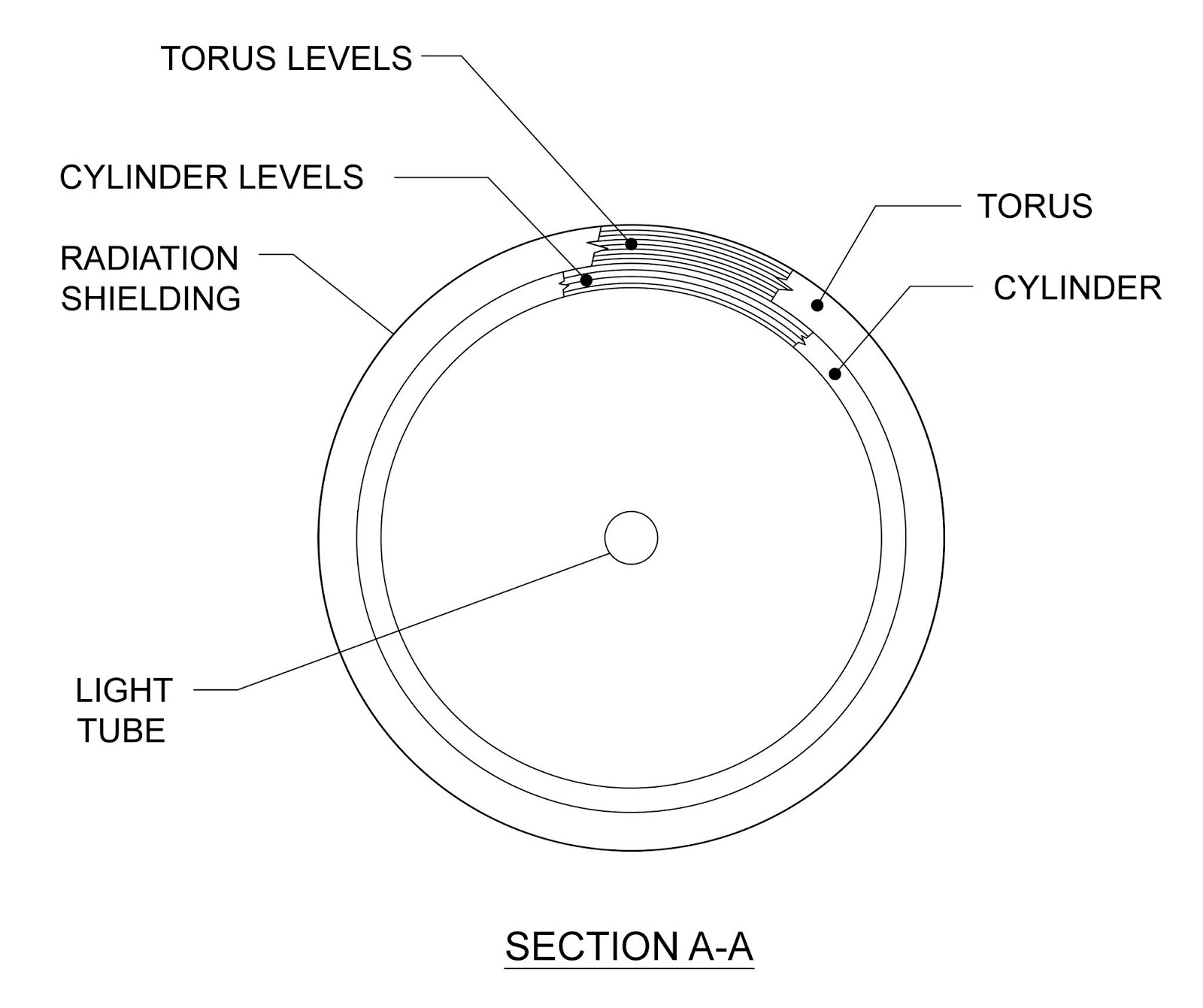
Using the study’s conclusions about optimal shapes and sizes, there is a variation that would be advantageous structurally and aesthetically. More bang for the buck could be had by using the torus geometry in the multiple side-by-side configuration to form a cylindrical habitat. The tori would essentially serve as the structure for the cylinder, eliminating a lot of material while providing about twice the living space (at approximately one g) of the habitat alone. The following drawings graphically describe this configuration. Click on them to expand the view.


This configuration will have living, work, and recreation space for between 2 and 3 million people, including about 3/4 billion cubic feet of storage. It is 1.3 miles in diameter and 3.2 miles long. Method of construction will be 3D printed molds to be filled with a slurry of powdered asteroid or Moon regolith, water, binder, and strands of carbon nanotubes. The parts will then be deposited in giant plastic bags to recover the water vapor while they dry. When the parts are cured, they will be assembled by manned construction vehicles and unmanned drones resembling rocket-powered octopi. 

Timeline: about 50 years hence. This will be when the first asteroid has been captured, corralled, and mined out. Realizing the unlimited future in space, the great flush of wealth produced will be used by the asteroid mining companies to fund projects similar to this habitat. 

The alternative to this design is to take a mined-out asteroid and turn it into a habitat. Students and researchers at Delft University of Technology are currently working on turning a hollowed out asteroid into a vessel capable of traveling to other star systems - an even more ambitious project than that proposed here. 

As we use up more resources, require more energy on our planet, and the climate becomes more hostile, we will look more often to the skies as a solution. It may get bad enough to view such habitats as preserves to maintain plants and animals that could be lost forever if left on Earth. In some ways, such a habitat may be safer and more comfortable than on Earth. There is no denying that once we escape the gravity well of Earth, the possibilities in space will seem endless as space itself. 


Other articles you may enjoy:


Wednesday, November 7, 2018

Oumuamua: Alien Probe or Asteroid? It Could Be Both

Oumuamua - courtesy NASA


Oumuamua is the strange cigar-shaped interstellar interloper that Harvard University professors think may be an alien probe sent to gather information on our Solar System. Slight changes in acceleration and direction have been given as reasons for this hypothesis. The theory is that it is the remnants of a “light sail” powered a now defunct alien probe. Oumuamua is Hawaiian for “scout”. 

SETI senior astronomer Seth Shostak thinks Oumuamua is just another comet or asteroid from very far away, as in another star system. That explains its unusually large velocity and its path directly through the Solar System. Comets and asteroids are known to vent gas, which acts like a thruster on a space ship to change direction, speed up, or slow down. Other scientists are skeptical as well.

I agree with Seth. It would be highly unlikely for the first chunk of material we’ve spotted from outside our Solar System to be an alien probe. Although it is much more elongated than other asteroids, it should not be construed to be a derelict light sail. It should be pointed out how likely it is that an alien probe would take on the form of an asteroid because it may actually be a hollowed out asteroid. Why is that? Convenience. 


Think about what our civilization is currently planning to do. We are going to mine the asteroids. So far, we are only thinking about mining the asteroids, but it will happen. We are running out of stuff on Earth, and there’s plenty of just about everything in space. The asteroid belt is a busted up planet, and it has the same materials we have here on Earth. 

A number of things are in collusion to boost asteroid mining. Nuclear fusion is about to happen. The helium-3 on the Moon will represent the outer space version of the gold rush for its ability to facilitate the fusion process. A NASA space station is currently planned for the Moon. As the helium-3 rush commences, a space elevator will be built on the Moon. Also, AI will come into its own, powering autonomous drones the asteroid mining industry will require to prospect and gut asteroids for a very fine profit. AI will also advance biomedical engineering and research, taking longevity in humans to biblical levels, making longer term projects more acceptable. 

All these things will come together in a very short time to initiate and accelerate asteroid mining. These mountains of minerals and metals orbit the Sun. Some of their orbits coincide with both Earth and Mars. Once these asteroids are mined, they can be outfitted with AI pilot navigators, living quarters, and science labs and used as comfortable, safe, fuel-free shuttles between here and Mars. They are safe because their mass protects against minor collisions and hard cosmic radiation. 

Want to go somewhere else? Stick a fusion drive on the asteroid powered by asteroid material and a little helium-3. Now, when it gets to Mars orbit, just keep going and explore the asteroid belt. If someone living in the asteroid belt were to see this spaceship, they would know it came from outside the belt because it is going a different direction and velocity than most everything else, just like we know Oumuamua came from outside the Solar System. It would seem a logical thing that this is what spacefaring races do when they get to a certain technological level. They mine asteroids and leave an outer shell to be converted to a spaceship, instead of hauling all that material out of some gravity well to build a ship.

This asteroid conversion scheme could be ramped up to hollow out big asteroids and turn them into large explorer vessels capable of going to nearby stars and checking out exoplanets for possible colonization. Fifty years ago Harvard’s paper on Oumuamua would be scoffed at as total science fiction created by hippy scientists smoking pot. With what we know is about to happen in this day and age, it still seems unlikely as a light sail but plausible as a probe. Fifty years from now, some researcher will run across that Harvard paper and laugh as he stubs out a joint in the recreation room of the Ceres Flyer, a converted asteroid riding a fusion flame to Alpha Centauri.

Other articles you may enjoy:


Monday, October 8, 2018

A Safer, More Luxurious Alternative to Currently Planned Mars Missions


Hyabusa2, Japanese space craft sent to explore Ryugu


The asteroid Ryugu comes relatively close to Earth twenty seven times before the end of the century. It also comes close to the orbit of Mars on its journey around the Sun. Some of those orbits will include both a close encounter with Earth and with Mars. According to the web site Asterank, on December 29, 2020, Ryugu comes very close to Earth, relatively speaking. It will be 0.061 AU, about 5.7 million miles, away. It will be even closer on December 21, 2033; a scant 4.4 million miles. These distances are 6 to 8 times closer than 36 million miles, which is the closest Mars gets to Earth, and a hundred times closer than 400 million miles, the farthest point. 

Orbits Ryugu, Mercury, Venus, Earth, Mars

What if we intercept Ryugu with autonomous drones towing the equipment necessary to mine Ryugu for some of the $83 billion dollars worth of nickel, iron, cobalt, water, and frozen gasses that it contains? This equipment is set up, solar panel arrays are unfolded and activated, and the asteroid swarms with prospector drones cataloging material and locations. All this takes place as the asteroid proceeds in its orbit about the Sun. It will be quite busy until a suitable load of material is collected and secured for a trip back when the asteroid comes close to Earth again. 

Plastic grocery bags prefer this as their second career. 


What if the holes and tunnels the mining drones excavate for ore are repurposed as living quarters for astronauts to hitch a ride to Mars, do a year or three of studies, and then hitch a ride back? That presupposes a workable spacecraft that can land on Mars and take off again after sitting months, possibly years, on the surface of Mars and be attached or otherwise stowed on our shuttle asteroid. Does this idea sound any more incredible than a ship that will do that plus make the journey from Earth to Mars while keeping passengers safe from radiation, bone loss, and well fed? Besides that, it would be there for future missions for hundreds of years into the future; a permanent, luxury shuttle to Mars and back. 

Ryugu; an asteroid about a kilometer in diameter.


A hollowed out asteroid could haul power, water mining, food growing, and shelter building equipment packaged in appropriate landers to Mars orbit. The asteroid shuttle could even be spun up to provide artificial gravity to minimize bone loss over the course of the journey.  A deep space tug stowed on the asteroid would drag this equipment from the asteroid to an orbit around Mars for insertion and landing. Autonomous robots could begin setting up camp, so to speak, getting ready for the human occupation. 

On the next trip, the asteroid shuttle will carry a vehicle with the ability to orbit Mars, land, and take off. Along with that vehicle will be the first people, a cherry-picked group of scientist explorers. With so much of their survival equipment already in place, the first humans on Mars will have much more time to devote to science rather than just staying alive. The asteroid itself would lend itself to a great lab for deep space, vacuum, and microgravity experiments. A good telescope would be included for closer looks at denizens of the asteroid belt.

Use those plastic grocery bags again. Save money. Save the world. Here’s how. 


This is pretty much the same scheme Elon Musk proposes, a two-part trip using the Big Falcon Rocket. Two BFRs locate water and deliver equipment in 2022. A second pair of crewed BFRs plus two drone cargo BFRs, in 2024, deliver more equipment and  the astronauts. 

NASA’s version of the Mars mission depends on the development of a Deep Space Gateway, DSG, sort of a mini-ISS orbiting the Moon. A Deep Space Transport, DST, would be NASA’s answer to SpaceX’s BFR.

Even if it were decided to use an asteroid as a shuttle to Mars, the BFR or the launch system for the DST would still have to be developed and used to get the bigger pieces of equipment into orbit for the mission. From there the BFR, DST, or a space tug would ferry the equipment to the asteroid at its closest approach to Earth. If the space tug is used, it would free up the BFRs to be loaded with some of the more expensive metals mined from the asteroid and haul that back to the Earth’s surface. Everybody wins! The Mars explorers would get there more safely and in much more comfortable quarters. Elon Musk makes money hauling exploration equipment into space and asteroid material down to Earth. The only musical chairs loser might be the DST, which is basically a deep space ferry similar to the space tug. But there definitely is still a need for this type of vehicle, and it may very well be used in conjunction with the BFR for the role of role of deep space tug. It may be better suited for that purpose than the BFR because a large portion of its capacity is not given over to reentry shields and landing engines as in the BFR. 

There are many asteroids that swing close to Earth on a periodic basis before making their journey around the Sun. They go to many places we would like to explore. It's a bevy of safe, durable, long-lasting shuttles to and from the extremities of the asteroid belt to the inner planets. We should take advantage of them. 

The exploration of space is a juggle of restraints put in place by the physical laws of our universe. In the end we must make a decision on how it will be done. Hopefully, that decision will be made with the safety of the crew uppermost in mind. Using an asteroid to make the journey to Mars and back sounds, on paper at least, like a safe, comfortable, less expensive route to take. It very much depends on how quickly and intelligently the asteroid mining industry advances over the next few years. 

Other articles you may enjoy:


Saturday, September 29, 2018

Sticking the Landing On Your Billion Dollar Asteroid


Spacecraft on an asteroid - courtesy Kevin Baird


Your autonomous drone is landing on Ryugu. Ryugu won’t be coming close to Earth again for another sixteen months. There are bills to pay that refuse to have another sixteen months tacked onto their due date. Ryugu is worth fourteen billion dollars in iron, nickel, cobalt, water, and some frozen gases. You can’t have your craft hopping around on the surface like the MINERVA II1A and MINERVA II1B minirobots launched from the Japanese space craft Hayabusa2 in September of 2018. It has to get down and stay down in a very fixed manner to do what has to be done to get that stuff back to market in Earth orbit.

It costs $4000 to recycle ton of plastic bags worth $500 on open market. 


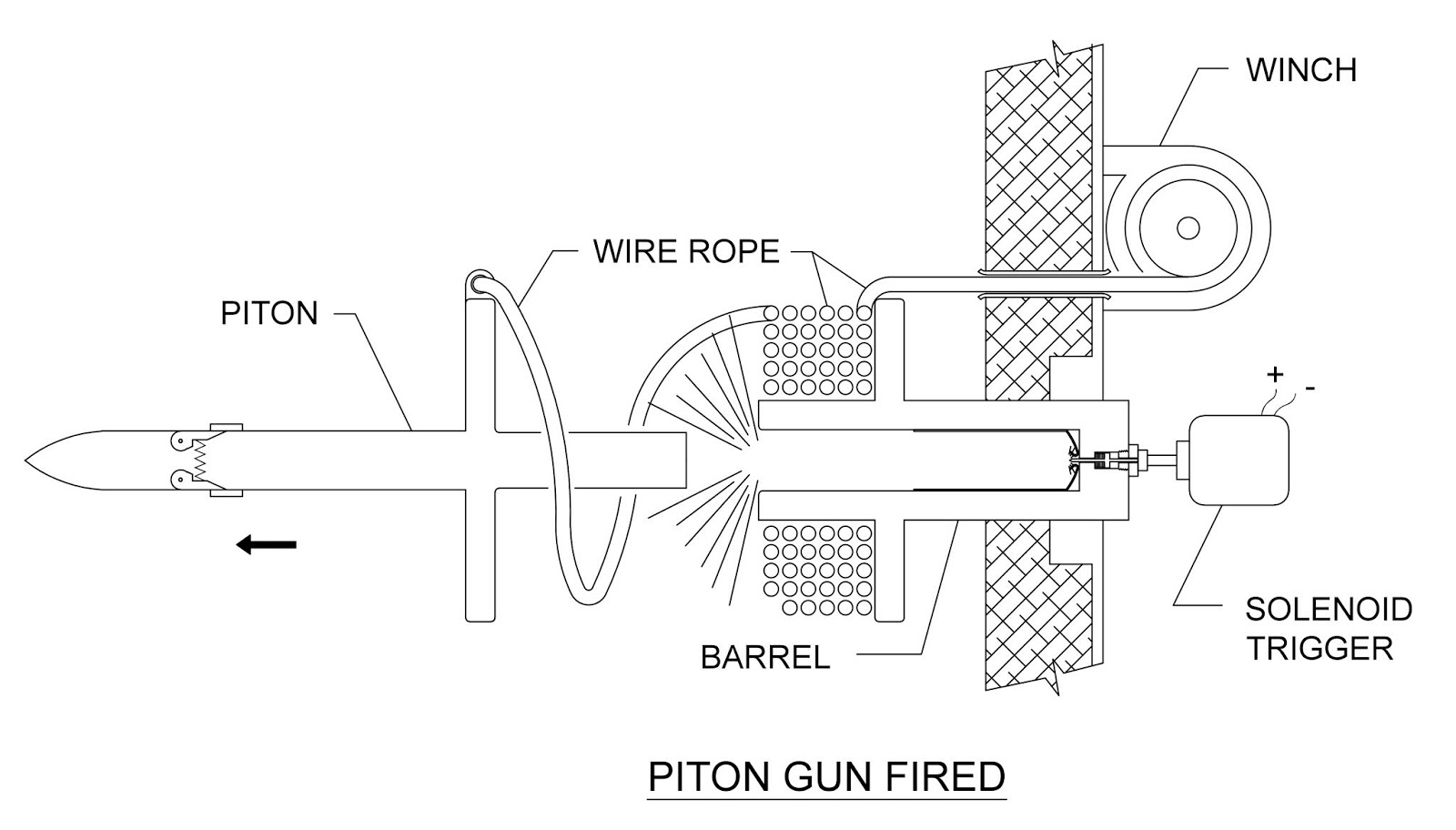
How are you going to do that? This is how it will be done. The basic method goes back 200 years to the age of whaling. Yes, I’m talking about a harpoon, but much smaller and only slightly more sophisticated. For the purpose of describing this contraption, though, it will be referred to as a piton, a more accurate and modern label. 

The diagrams will be useful to look at along with the written description. They are all sectional views cut down the center of the mechanism. The piton mechanism will be powered by an explosive charge. Gunpowder would probably work, since it carries its own oxidizer and is perfectly capable of exploding in the cold vacuum of outer space. About a half inch or thirteen millimeters in diameter, it is made of tungsten carbide. A small diameter wire cable connects the piton to the drone through a small cable guide to a powered winch inside the drone. 


Once the drone is close to the surface of the asteroid, the solenoid trigger will hammer down on the firing pin, the charge will go off, and the back portion of the piton that fits in the barrel will be shot out like a large shotgun slug. Spring-loaded latches near the front of the piton have been held in place by a soft metal band around the shaft. This will be scraped off as the piton travels into the asteroid material, activating the levers. The piton will stop as the flange that restrained the coiled connecting wire hits the surface. The levers will expand outward and keep the piton from slipping back out of the hole it just made, much like the barb on a harpoon keeps it from backing out of a whale.

Paper bags take 5 X the water to make and 7 X the fuel to transport than plastic bags 


There will be four to eight such pitons. There would likely be redundant sets. If the first set does not work or is only partially successful, adjustments can be made and the second set then deployed. Once the piton is securely fixed, the winch begins to retract the excess wire rope until it is tight enough to hold the drone down without ripping out the piton. Now you can deploy those drills and hammers on the surface without your drone bobbing around like MINERVA IIs. 

What if the pitons don’t work? We’re talking billions of dollars. There should be a backup system. The backup for the pitons is a two part epoxy driven into place by a pressurized piston. Once again, the diagrams will be helpful. Basically, a two part epoxy is shoved through mixing vanes when a solenoid is triggered, allowing pressurized gas into the epoxy cylinder. The epoxy piston takes the mixing vanes with it as it shoves everything into a carbon fiber hood that is next to the asteroid’s surface. This hood is slotted to allow excess mixed epoxy to ooze out underneath. What is not shown in the diagrams are the carbon fibers attached to the inside of the hood to provide a good structural connection between the epoxy and the hood. If the piton charges haven't cleared dust and debris from the surface of the asteroid, the drone may have to squirt it with the rocket engines before repositioning for applying the epoxy. 


Once the epoxy is in place, heating elements in the form of wires attached to the carbon fiber hood provide enough heat to cure the epoxy. Two part epoxies can be engineered for outer space. One of the most stringent standards for such an epoxy is ASTM E595, which mainly concerns the outgassing of epoxy. That is not relevant for this application since the epoxy is outside of the spacecraft and the spacecraft is unmanned.

Why this concern for what seems to be a minor detail in the greater scheme of mining the asteroids? For one thing, there is no minor detail. They are all important. The idiom 'the devil is in the details' was originally, and more correctly, 'God is in the detail'. The secure and structurally sound placement of a craft against the surface of an asteroid is a very important prelude to actually being able to do work on that asteroid. It is one of the many tasks the autonomous drones will be asked to carry out. The success of these tasks will be reflected in the proper design of the tools we give these machines to work with. 

Other articles you may enjoy:


Thursday, September 6, 2018

What Will Be the Most Common Currency In a Future Space-Based Society?


Courtesy NASA

Gold coins? Platinum pellets? Grains of cobalt? I predict water will be the preferred currency in outer space. You can drink it, bathe in it, breathe it (oxygen), burn it in rocket engines (oxygen and hydrogen), grow things (hydroponics), and protect yourself from radiation. 

Water is easily stored, shaped, and divided up for transactions. It can be flash frozen and quickly thawed with the deep cold of space and the intense radiation of the Sun.


Paper bags take 5 X the water to make and 7 X the fuel to transport than plastic bags 


The current method of water storage in space looks like duffel bags with a spout as this picture reveals. This astronaut is obviously reveling in the fortune of water surrounding him. That water is worth $83,400 per gallon based on the current cost of $10,000 to put a pound of something into orbit. Hopefully, it is Evian or Fuji.


Water storage aboard ISS - Courtesy NASA

Or one could build a palace of ice in outer space. There is that much water available on some asteroids. Just make sure the seal between the ice and the airlock stays frozen solid. 

Small entrepreneurs will make their first fortunes by seeking out chunks of ice in the asteroid belt or simply mining close-flying asteroids for the liquid gold. Planetary Resources, an actual asteroid mining company, has recently stated that it will concentrate on water instead of precious metals as its first acquisition. 

Water globule floating on ISS - courtesy NASA


The companies that first acquire water in space will be like the merchants that made fortunes selling picks and shovels to the forty-niners in the California gold rush. 

The importance and value of water will demand that water recycling and reclamation units aboard space vehicles and habitats be ubiquitous and efficient. Even if someone dies in space, the water in their body will be reclaimed before burial in space or transportation back to Earth. This will be part of a signed agreement when someone goes to work in space. Their immediate kin will get some portion of the value of that water in space, even if they are on Earth. 


Saving the world one bag at a time. Recycling genius.  


Security will be a concern as well. When a worker’s contract ends, what’s to keep him from filling flexible bags of water and hiding them about his body and carry-all? When he gets back to the orbiting end of the Lunar Space Elevator or a space station near Earth, he turns his water in for some Earth-based currency like gold or platinum before going back to the planet. 

The biggest non-recoverable expenditure of water in space will be for rocket fuel. The biggest recoverable use for water in space will likely be radiation shielding. It is efficient over a spectrum of radiation including cosmic and gamma rays. In fact, radiation shielding may be designed to not only protect against radiation but to be a reserve source of fuel as well. 

It is possible a water-based currency, both physical and digital, will be established in a space-based culture of dozens of companies and thousands of workers. Since water melts so readily, the gold coins, platinum pellets, or grains of cobalt mentioned before might actually be used; and they will represent some predetermined amount of water. That amount will most likely be decided by some committee with all of the space-based companies represented. The value of water will fluctuate as discoveries are made on asteroids being mined and unrecoverable expenditures of water such as rocket fuel are used up. There may one day be a cryptocurrency based on water - H20coin, of course. 

The actual water will be kept in some safe place, a giant chunk of ice hidden, or well-guarded, or both. As a matter of course, owners of large quantities of water in space will, at some point, have that water melted and mixed with some small amount of radioactive isotope to “brand” it. It won't be enough to affect health, but it will be easy to track if it is stolen. 

There is probably more water in asteroids than on Earth. Its value in space comes from the difficulty and expense of finding and securing it. Those who do this first will be the future lords and princes of outer space. They will control the lifeblood of space.

Other articles you may enjoy: