Showing posts with label gamma rays. Show all posts

Tuesday, September 4, 2018

Workers In Space Will Live In Igloos


Courtesy Kordite at flickr


The mining of asteroids will begin in earnest within the next 10 to 100 years. The asteroids chosen for retrieval and processing will almost certainly contain water because water will be one of the most valuable commodities in space, if not the most valuable. Not only does water contain hydrogen and oxygen for rocket fuel, humans need it for survival; and it is very efficient at stopping many types of radiation. 

If a current or future corporation is going to make a decision on which asteroid to go after, the metal content of the asteroid may not be the deciding factor. Asteroids with little or no water will be passed up for mining at least in the early phase of the industry. If our civilization remains technically and economically viable into the 22nd century, the asteroid mining industry should be hitting its stride and keeping economic growth positive for several hundred years. Even after this maturation, the industry will favor those space rocks containing water simply out of habit and tradition unless some special material is needed that can’t be found in combination with water. Another outlier would be a leap in engine technology, such as a compact fusion drive, that would mediate the reliance on water as stored rocket fuel.


Use those plastic grocery bags again. Save money. Save the world. Here’s how. 


Let’s say some future company is evaluating two different asteroids for mining. One, 1999 JM8, is a nickel, cobalt, and iron asteroid worth $45 trillion dollars. It is fairly large at 4.35 miles in diameter, but only .024 Astronomical Units away at its closest approach to Earth, approximately 2.2 million miles or about ten times the distance from the Earth to the Moon.

Another asteroid, 1950 KA, is worth only $33.4 trillion dollars and is .097 AU at its closest pass to Earth, nearly four times that of 1999 JM8. It has a couple of things going for it, though. It is only 2.17 miles in diameter and has a composition of nickel, iron, cobalt, water, nitrogen, hydrogen, and ammonia. 

This company will pick 1950 KA because of the water, hands down. Once the robotic retrieval craft gets to 1950 KA, it can mine water; and, with the abundant solar energy available in space, split it into hydrogen and oxygen for rocket fuel to move that mass back to Earth.

Courtesy NASA


After 1950 KA is parked in orbit near Earth in one of the Lagrange points L4 or L5, the real fun begins. Using many specially designed, semi-autonomous robots, the asteroid is scraped, tunneled, bored, melted, smelted, hammered, drilled and crushed to extract its treasures. In the early going of asteroid mining, however, it will not be done without humans. We will be there to direct the overall strategy and change tactics when necessary, not to mention repairs and hands-on inspections. This is only because artificial intelligence will not yet be up to the autonomous decision making required of mining asteroids. 


Plastic grocery bags prefer this as their second career. 


Human workers need a safe, even comfortable place to stay while performing these chores. Safe by logical necessity and comfortable to attract the type of person needed for this work given how long they will have to be in space. Money can only go so far as an incentive. Intelligent, athletic, engineering and scientific types only need apply, similar to astronauts in education and ability. 

Here is where the water comes in. These people will be shielded from radiation by a wall of water, actually ice. As I mentioned above, water is very efficient at shielding many types of radiation, including that from solar flares, gamma radiation, and cosmic radiation. Although NASA has been working on a lightweight polyethylene plastic called RFX1, it has some serious problems in competing with water. One, you can’t drink it. Two, it has to be hauled up the gravity well of Earth. 

Exactly how will water be used as a radiation shield? Three feet of water or ice will intercept and diffuse almost any radiation, including gamma rays and cosmic rays. Since there is plenty of water available from the asteroid, it makes sense to protect the entire facility instead of providing a vault or other safe area that people have to go to. At some point, an unexpected sleet of radiation is bound to sweep through the area. This way everyone will be protected all the time unless they are doing something outside of the habitat and not working inside the asteroid.

The geometry of the habitat will resemble a thick hockey puck. This will rotate to provide simulated gravity to the inhabitants. On the unit shown in the drawings, eight rotations per minuted will provide nearly one g at the outer wall or "lower" level. The second level will provide three quarter g, and the "upper" level one half g. The center on one side will have a docking facility. The center of the other side will sprout a boom about as long as twice the diameter of the pancake. At the end of this boom will be thrusters that can point in almost any direction. These thrusters will be powered by, you guessed it, electrolysed water in the form of hydrogen and oxygen burning to form, once again, water.

CLICK TO ENLARGE


Not only is it a habitat, but it can move around as required to view different parts of the asteroid or move equipment that is not self-motile. It will pick up and drop off people at the orbital end of the Lunar Space Elevator. It will be a habitat, taxi, and tug. Some may call it the "Ice Palace", but it’s a given the majority will nickname it the "Igloo."

CLICK TO ENLARGE


This three foot barrier of water will remain frozen because space is cold. Solar energy hitting the outside envelope of the vessel may have some effect, but as that surface rotates into shadow, it will become frozen again. The inside surface of the ice barrier will be in a constant state of melting. The human habitation will necessarily give off heat. No matter how thick the insulation, it will eventually melt this inner surface. This water, through centripetal forces will be routed to the outer surface where it will be refrozen. This ice barrier is a good buffer between the 70-75 degrees Fahrenheit in the habitat and the minus 450 degrees F. of outer space and will probably vary in temperature, getting colder from the inner to outer surfaces.

The lure of infinite wealth and energy will be too strong for capital to resist. A lot of money will be spent on this endeavor. Hopefully, it will be spent wisely, and progress will be swift and beneficial not only for those companies involved but for the rest of us as well. The bottleneck is the gravity well barrier that is currently so expensive to vault. Space is kind of like Vegas; what happens there stays there. However, companies like Obayashi Corporation are working on building an elevator to space. This would drastically reduce the cost of sending stuff into orbit and bringing it back. Their plan is to have it built by 2050, waiting only for the successful mass production of carbon nanotube fibers long enough to use. Hopefully, their prediction will not become similar to the refrain of nuclear fusion developers of having a practical fusion generator within thirty years … every year. While the industry can have some success with rockets, it will grow by leaps and bounds with a working space elevator.

Other articles you may enjoy:


Saturday, November 25, 2017

We Will Live on the Moon: the How and Why

There has been some interest on the internet lately about lava tubes on the Moon. These have been known about for some years, but there hasn't been enough said about what this means to us as a supposedly intelligent race of beings on the cusp of becoming a spacefaring civilization. It brings a focus on the Moon as a candidate for a jumping-off station to the rest of the Solar System and beyond.


For the cost of 4 macchiatos you can have plastic trash bags for life.


Two separate studies of the Moon have identified ideal places for a lunar colony. In 2011, NASA's Gravity Recovery and Interior Laboratory, also known as GRAIL, consisting of two spacecraft, Ebb and Flow, mapped the gravitational field of the Moon in great detail. In 2007, the Japanese space agency, JAXA, used the spacecraft Kaguya, to map the Moon from orbit using a magnetometer, radar, and imaging instruments.

Fig. 1 
The Ebb and Flow spacecraft from the
NASA project GRAIL

Fig. 2 
Kayuga spacecraft from the Japanese
space agency JAXA

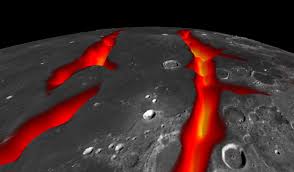
What they discovered was the presence of ancient lava tubes beneath the surface of the Moon. Thirty miles long; 340 feet wide; and, by some accounts, 3000 feet tall. There may be many such underground caverns on the moon.

Fig. 3 Artist's interpretation of the active
volcanism that create lava tubes and
pit craters or sinkholes.

Fig. 4 Pit holes or sinkholes are collapsed roofs
of lava tubes. About two hundred have
been found on the Moon.

Fig. 5 String of pits
following a lava tube.

Besides being excellent candidates for collection sites of lunar ice, these would provide protection from the -298 to +224 degrees Fahrenheit swings of temperature found on the surface of the Moon. Protection from radiation is another important consideration. We take it for granted, but the Earth with its electromagnetic force field and atmosphere protects us from ionizing radiation coming from the depths of space. Cosmic rays are strong enough to rip apart atoms in human genetic material, making cancer and mutations much more likely. Radiation storms from solar flares can cause so much damage to unprotected human tissue that sickness or death are very likely. Radiation can also play havoc with electronics that are not properly protected: thus, the protracted angst concerning the possibility of a nuclear weapon in orbit that, if exploded there, could take out a continent-sized swath of Gameboys and iPhones. Civilization would be doomed.

Fig. 6 Illustration of the formation of a lava tube on the Moon.

It takes 4" of lead, 10" of steel, 24" of concrete, or 36" of packed dirt to properly shield humans from radiation. Now you get an inkling of how difficult the trip to Mars in a space ship is going to be. Can you imagine the fuel required to move a spaceship made of 10" steel plate? Of course, it will just be a small emergency room lined with special radiation absorbing plastic, but it is still extra weight. So, to find a radiation shelter ready-made on the Moon is amazingly wonderful news. The perfect hideaway for a lunar colony. But why? I mean why a colony on the Moon?

Plastic grocery bags prefer this as their second career.


Mankind is at a dangerous juncture. There is a real threat of the planet running low on critical resources. Climate change may be worse than we think. A super volcano could erupt. An asteroid could strike. A super-flu virus 3 times worse than the 1918 flu pandemic could decimate humankind. Therefore, we need a permanent, self-reliant human presence in space to carry on should any of these things take mankind back to neolithic levels of technology.

But impending doom is apparently not a good impetus for the human race to do anything. Even with all that stuff going on, a lunar colony is not going to happen if there is not money or its equivalent in the game. Good old greed is what we need to set the wheels in motion for a colony on the Moon. So, what is on the Moon that is worth us going back to it, sprucing up one of these lava tubes, and sitting around the metaphorical campfire in the cave feeling smug about finally being in space on a permanent basis?

Great way to carry your groceries; + trash, dirty clothes, food prep waste, garden clippings, etc.


As everyone knows, nuclear fusion will be a reality in 20 years. Ahahahahahaha! No, really. It could be. It's very close now. Helium-3 can make nuclear fusion much more efficient and eliminate nuclear waste and radiation. Several governments have plans to mine the Moon for helium-3 to facilitate nuclear fusion. Based on how much energy it would produce, it is worth about $3 billion dollars per metric ton. There is an estimated 1,100,000 metric tons trapped in lunar soil. That is $3,300,000,000,000,000. It would have to be cooked out of the regolith at 1100 degrees Fahrenheit, so the lava tube would make an excellent location for a helium-3 processing plant.

Fig. 7 Inside the Alcator C-mod tokamak 
used in nuclear fusion research.

Other elements in relative abundance are oxygen, aluminum, calcium, titanium, silica, and iron. You might think these would not be for export (except, maybe, the titanium and the oxygen), and that they would mainly go toward helping build the lunar colony. They would, but think of the possibilities. Titanium, aluminum, and iron (used to make high-grade steel) in combination with 3D printers that print with even high-temperature metal will make the Moon the Home Depot of the Solar System. Spacecraft and space habitat parts will be designed on Earth. These files will be sent to the  Moon where they will be printed out. From the Moon they will be lifted into orbit for much less than the same parts coming from Earth. Not only is there one sixth the gravity, the rocket taking it into orbit will be magnitudes cheaper because it can ignore streamlining and thermal insulation. A surface to orbit moon lifter would be an ungainly looking device, mostly metal frames encircling the cargo pod with rocket motors attached to that frame.

High temperature ceramic parts can also be made from material on the Moon. These are critical for some space applications. The lunar crust is about 40 percent oxygen so there will be no shortage of that for breathing or burning.

There might be a future for powdered aluminum as rocket fuel as well. This, in combination with the obvious oxygen, and the Moon becomes the Exxon Mobil of the Solar System.

Water! Six hundred million metric tons of water at the north pole of the Moon. Similar conditions (perpetual darkness) exist at the south pole, so there could be twice that much. Drinking, bathing, and hydroponics would be the main human uses. It would still be considered an extremely valuable resource and recycled over and over ad infinitum a la Dune. The other uses would be industrial; perhaps as a coolant for machining metal parts but certainly for splitting into oxygen and hydrogen for their usefulness in industrial and chemical processes. The hydrogen would be more important since there is plenty of oxygen in the lunar regolith. 

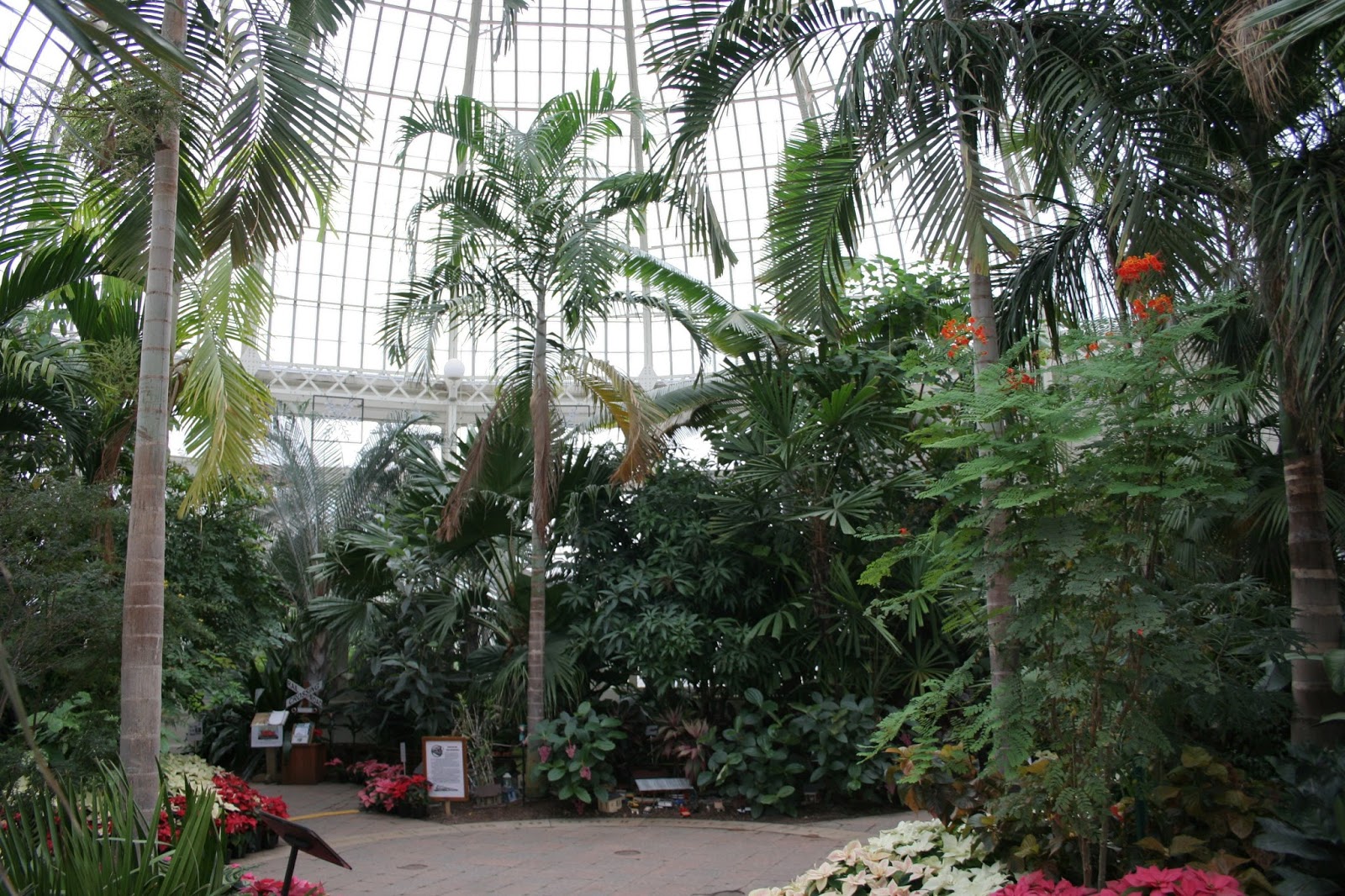
One lava tube has a sinkhole that is almost perfectly circular. Imagine that portion of the lava tube used for a colony or Moon base. Silica is converted to glass to completely cover this sinkhole with a glass dome or ceiling. The whole thing is converted to a giant greenhouse/ hydroponics garden. Food could then be grown on a scale making export feasible. The water would also be sold to spacecraft making the Mars/Earth trip cycle and to space habitats near the Lagrange points of the Moon. Exporting all that food and water would make the Moon the Safeway of the Solar System.

Fig. 8 Lunar garden dome; the tourist section 
next to the Lunar Hilton.

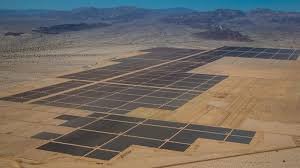
Power! People are not going to complain about that solar panel farm in their back yard on the Moon. There is a lot of space to soak up the Sun's rays and they aren't weakened by atmosphere. Photovoltaic panels will absorb about 20 percent more energy because of this. Silicon, the main ingredient in most solar panels, is the second most prevalent element in the Moon's crust, oxygen being the first. The panels can be made right there on the Moon. Now you can make virtually as much power as you need to do anything you want and have enough left over to sell by microwaving it to spacecraft, satellites, and space habitats that may need it. This makes the Moon, you guessed it, the Consolidated Edison of the Solar System.

Fig. 9 This would be a small solar panel installation on the Moon.

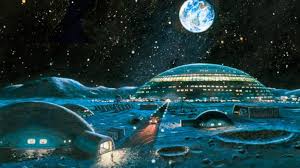
We've only been talking about physical stuff. There are other sources of treasure on the Moon. Tourism is one. A lot of wealthy people would be willing to plunk down good money to come to the Moon and stay at the Lunar Hilton. Besides going to the greenhouse dome, strapping on wings and flying (break a plant, you buy it), they could take trips to see where man first set foot on the Moon. Don't forget to buy that little souvenir cube of lunar rock before you go home. Doomsday preppers might consider it the ultimate survival bunker. People that find it hard to move around would go there for the burden lifted from their bodies. Military high ground is another. That aspect is worth a lot to governments. No major nation is going to let another nation claim the Moon for themselves for this reason. That is why there is likely to be international cooperation just so everyone can keep an eye on everyone else. Science is another. What a great place for giant telescopes. The low gravity and vacuum will be a natural laboratory for many experiments.

Fig. 10 The Lunar Hilton

These are the reasons we will live on the Moon. These are the reasons we should be tripping over ourselves getting back to the Moon. Men with vision and resources like Elon Musk, Sir Charles Branson, and Jeff Bezos should lead the charge in an obvious next step in our conquest of space and guaranteeing the continuity of the human race. Governments should realize the validity of these ideas, these realities, and make it easier by participating in the finance and technology of such an endeavor. To the Moon!

Fig. 11 The Moon.

May you be inspired.

Glen Hendrix

Other articles you may enjoy:


Sunday, March 4, 2012

Think, People, Think

Through the media we are bombarded by strife and the rumors of strife. Our leaders find it hard to focus on long term issues because of political turmoil, recessions, famine, nuclear proliferation, or civil wars. The very structure of our government and economy is such that problems are dealt with on an election by election or quarter by quarter basis, leaving little time for future planning. We seem to be in a constant state of flux. We should be doing better than this. We must do better than this.


Saving the world one bag at a time. This is recycling genius.


There are some that wax philosophical about the continued existence of the human race. They compare our existence to the dinosaurs and make the argument that all species have a “lifespan.” My argument is that we are smarter than the dinosaurs and, yet, it looks as though they will have lasted about 100,000 times as long as we will since their reign was 650 million years and it looks like our technological civilization is only going to make it about 6,500 years Okay, we don’t have armor, large teeth, tons of muscles, etc.; but we do have an obscenely large brain to weight ratio. Problem is we’re not using that for the long-range planning needed to give T-Rex a run for the money.

Except for the handrails near the top, this was a typical Earth scene for 160 million years. 
  © Copyright Hywel Williams and licensed for reuse under this Creative Commons Licence

If humankind insists on keeping all its eggs in one basket (staying on Earth), the universe is bound to make an omelette someday. Whether it be an asteroid strike, a spray of high-energy gamma rays, or a super volcano eruption, the results will be the same. Civilization will go back to a handful of survivors living at a primitive level of existence.

Asteroid Strike

We should be striving now to develop the technologies we need to protect the planet, go beyond our cozy envelope of air, and start extracting resources and energy from the Solar System at large. I’m not talking about further development of rockets. We’ve got enough products of combustion to deal with. We need to develop a space elevator. It is the only way to get significant loads into space cheaply and often. I describe a seriously practical scheme for one in my book Transmat World.

And I’m not talking about a colony on the Moon as our next space project as Newt suggests. Actually, the the prospect of harvesting helium-3 from the Moon could be lucrative but, in general, we want to avoid gravity wells. They are expensive and there are too many alternatives. The asteroid belt contains the material we need to thrive in space and it floats there, waiting to be harvested. We have the technology to capture these asteroids, bring them back to Earth, and sculpt them into space habitats after mining them for useful metals and minerals. These technologies are also described in more detail in Transmat World and other blog posts: The Space Mirror Hack, Asteroid to Habitat: The Transformation Begins, and The Space Egg.

Use those bags again. Save money. Save the world. Here's how.

We have to use our huge brain anomaly to consider the simple solutions for major problems that could arise. For instance, a nuclear winter has several possible causes that have nothing to do with war. It can also be caused by volcanoes or an asteroid hit, making it one of the more likely doomsday scenarios. The weather conspires to destroy crops for several years in a row causing billions of people to starve. The solution? The emergency mushroom kit. Mushrooms, a good source of protein, can grow in very little light making it the perfect go-to crop for this disaster. Has anyone investigated the viability of this simple solution? Do our governments have mushroom spores for the multitude stored in vaults along with the Ark of the Covenant? Very doubtful, but it could be a simple, inexpensive thing that would save billions of lives if the worst happens.

Could mushrooms be the go-to crop?

  © Copyright Pam Brophy and licensed for reuse under thisCreative Commons Licence


This is the simple, mindful type of technology we need to be thinking of and developing for the future of mankind here on the planet and beyond the confines of Earth; a future that is not stark and limiting but boundless and full of energy and promise. So start thinking.


Thanks for your time. My name is Glen Hendrix and I invite you to comment on this blog.