Showing posts with label fossil fuels. Show all posts

Sunday, May 12, 2019

The Environmental Advantage of a Space Elevator


image courtesy Obayashi Corporation 


Climate change is big. It’s bad. Don’t let anyone tell you otherwise. It’s going to be a rough few hundred, maybe few thousand, years for humanity. The short term view is not encouraging. The fossil fuel energy companies are going to fight tooth and claw to keep selling combustibles. The long term view is more optimistic. As the adverse affects of climate change begin to multiply and intensify, naysayers will be silenced, and social pressure will mandate change. Will it be enough soon enough? Hard to say. If mankind ever gets this CO2 problem under control, we will be looking at different ways to do business that protects the Earth in a more proactive manner, keeping the environment as ideal for life, all life, as possible. 

A space elevator may be the key technology for mankind to have it’s cake and eat it, too while the Earth’s climate rebalances. With a space elevator, all the nasty industrial processes that require a lot of energy and cause a lot of pollution could take place in orbit around the Earth. The end products of those orbital industries could then be more easily and cheaply transported to Earth via the space elevator. 

A space elevator could also preserve planetary resources. The materials needed for these myriad industrial processes may not even need to come from the surface of the planet. Most can be found in the asteroids or on the Moon. Need fuel? Load up an orbital tanker from a methane lake on Titan, one of the moons of Jupiter.  Need water. Find an asteroid made of water and mine it. It is estimated half the water in the oceans came from a bombardment of water-bearing asteroids.  Need metal? Nickel-iron asteroids are plentiful. Need energy? Build focusing mirrors for heat and solar panels for electricity. 

How does a space elevator work? Take a piece of string with a weight on one end. Pick the string up by the weightless end and spin around until the weight is straight out from your body. A ladybug makes an amazing landing on the string and starts walking out the string to the counterweight. You are the Earth, the string is the elevator cable or tether, the weight is the counterweight, and the ladybug is the car that goes up and down the cable. It’s not a perfect analogy, but it gives a good idea of what and where the major parts are. The counterweight would be about 60,000 to 90,000 miles up from the Earth’s surface. The center of mass of the whole thing should be at geosynchronous orbit, about 22,000 miles up. Now quit spinning and sit down because you’re gonna be dizzy. 

Currently, carbon nanotubes are in the running to be the material that can withstand the tremendous stresses of this application. Someone just has to figure out how to make a 60,000 mile long ribbon of the stuff with no imperfections. Meteoroids and space debris are a major problem. Protective measures must be implemented. A major clean-up of our space debris may be in order before we invest in such a mega-project as the space elevator. 

With the polluting industries moved to orbit, imagine the Earth as a giant natural park. Yes, we’ll live here, but not as obtrusively as before. One counterintuitive idea would be a further consolidation of humanity into supercities. Megalithic structures would house humanity. Supercities could eliminate untold millions of miles of transportation because everything and everyone is so close. Walking would be the preferred mode of transportation along with personal electric scooters and elevators. 

It would free up a lot of land for planting trees and other plants to sequester CO2. Meat would be grown or fabricated in a lab. Multistory greenhouses would grow our vegetables and grains. Supercities would be connected by high speed underground subways like Hyperloop. Other means of transportation will be electric drones and hybrid airships that can flip between heavier and lighter-than-air modes of flight. 

I know what you’re thinking. This is all such pie-in-the-sky fantasy stuff with no connection to reality. Fifty years ago, so was AI, GPS, autonomous vehicles, internet, and personal computers. The future looks bright. If we can just get there. Let us hope our immediate future holds in store political allies to humanity and the planet instead of what we have now. 


Other articles you may enjoy:


Carbon Capture and Sequestration (CCS): The Existential Technology We Are Ignoring


There May Be a Quadrillion Dollars Lying About on the Moon

Mining That First Asteroid - Manned Mission or AI?

A Convergence of Technologies Will Create a New Age of Space Exploration


The Space Habitat Revisited and Revised


Sunday, April 28, 2019

Carbon Capture and Sequestration (CCS): The Existential Technology We Are Ignoring


Photo by Cata on Unsplash


Our modern lives insulate us from and make us forget a knowledge that came simply and unforgettably to our hunter-gatherer forebears. That is the discrimination between needs and desires. We don’t need smartphones, automobiles, TV, indoor plumbing, granite countertops, Nikes, non-fat lattes with caramel drizzles, YouTube, scented candles, or video games. We do need food, air, water, a modicum of shelter, and a proper temperature range in which our species can exist. The last was a given until recently. That’s why there’s no life on Mars or Venus—too cold, too hot. The fact that temperatures go up in lockstep with CO2 levels now makes CO2 capture and sequestration mandatory to provide us with one of our necessities, a livable temperature range. 

If you want to make a lot of money, figure out a cheap way to remove CO2 from the atmosphere and stash it somewhere for several hundred years or forever. Everyone will thank you and shower you with cash. Ahahaha! That’s not true, but it should be true. Unfortunately, Trump is gutting U.S. funding for research in this area. That leaves the Chinese as the world leader for this technology. At the rate CO2 levels are increasing, we may end up renting the technology from them. Ironic, since they probably stole the idea from us to begin with. 

Since energy companies revealed they are spending 5 trillion dollars over the next decade for fossil fuel exploration, it is a foregone conclusion that CO2 capture and sequestration (CCS) will be a technology of existential necessity.  The fossil fuel industry has an enormous cache of wealth acquired at the expense of the Earth’s climate. They are going to use that wealth to continue doing what they do by gaming the legalized bribery system at the heart of many of America’s problems—lobbying. The energy companies plan to sell combustibles until fossil fuels are gone, they are too expensive to extract at a profit, or their client base has plummeted due to “natural causes.” 

We are currently at 413 ppm CO2. We are on track to hit 550 ppm by end of century. This will raise average temps 10.8 degrees Fahrenheit.  At some point in the next century, if we keep going at our current rate, we could see 700 to 900 ppm CO2, something not seen since the Eocene some 50 million years ago. Temperatures were up to 25 degrees Fahrenheit higher on average. There was no ice at the poles, but probably alligators and palm trees in Antartica. 

Looking at past geological records, it appears there is a lag time of one to four centuries for sea levels to catch up to rapid changes in CO2 levels. None have been as rapid as the last 200 years. We know that sea levels were a hundred feet higher during the Miocene, 15 million years ago, when CO2 levels were similar to what we have now. The reason we don’t see that large increase in sea levels or the 11 degrees F. higher temperature yet is because of the buffer provided by our still-cool, deep ocean waters. Ninety percent of the ocean is between 32 and 37.5 degrees Fahrenheit. But over the next couple of centuries we will see increasingly rapid elevations in sea levels and temperature. 

If we burn the rest of our fossil fuels scientists estimate atmospheric CO2 levels could rise to 1000–5000 ppm. If it is toward the upper limits of this estimate, it is debatable whether life will continue as we know it on Earth. Before we get there fossil fuel companies will, hopefully, realize they could lose their customers and, therefore, make some changes. These same scientists say just 450 ppm will be disastrous. It is a certainty we will reach that. With uncontrolled fossil fuel use and no capture and sequestration, CO2 levels will easily blow past 500 ppm; and our civilization could collapse under the strain of drought, food chain disruption, defrosted pathogens, resource wars, heat prostration, and tropical diseases. 

That is where CCS comes in. Various means of scrubbing CO2 from the air have been developed. It is then used for making lubricating oil and putting the fizz in soda water. Those are pretty small markets for the amount of CO2 we need to eliminate. Plus, who is going to pay for it on the industrial scale that is required. It would be ideal for those responsible for the CO2 in the first place to pay for capture and sequestration by implementing a carbon tax or a cap-and-trade schemeOtherwise, we are simply paying to clean up the energy companies’ mess which, in the end, may not be out of the realm of possibilities.

In the past it was thought that CO2 capture would have to take place at those industries where it is produced—chemical, power, concrete, steel, and fertilizer plants. Then it would be pumped somewhere to be injected into the ground. This is very expensive and unlikely to be adopted. 

A recently developed CCS technology allows carbon to be extracted directly from the air. Not oddly at all, it is called Direct Air Capture (DAC). With current technology it may be possible to get this down to about $100 dollars per ton. It needs to be ten times less expensive ($10 to $20 per ton) not to be a drag on the economyThis is the only technology that can realize a carbon negative offset. In other words, it could remove more carbon than is produced by mankind and nature to reduce overall levels in the atmosphere. The only alternative coming close is massive reforestation and afforestation. These have their own sets of problems and need funding to iron out the bugs. 

The problem is money. No one except a few universities and Bill Gates are spending money in the U.S. to develop this technology. It is not enough that we strip carbon out of the atmosphere. It must be put in a stable environment or condition and left there for hundreds, if not thousands, of years. Turn it back into limestone? Make CO2-foamed concrete? Make plastic to feed our 3D printers? Plant all available land with trees? I don’t know. That is why we need some smart people working on this right away.

Environmentalists are in a moral tug of war about CO2 capture and sequestration. Some believe it will give the fossil fuel companies an incentive to keep on doing what they are doing. That ship has sailed. We cannot be picky now about how carbon is removed from the atmosphere. It is all good, but CCS offers at least the possibility to reverse the levels of carbon in the atmosphere, staving off the worst of global warning until the climate stabilizes at a reasonable temperature—one of the basic needs that will allow us to keep on drinking non-fat lattes with caramel drizzles. 


Other articles you may enjoy:

There May Be a Quadrillion Dollars Lying About on the Moon

Mining That First Asteroid - Manned Mission or AI?

A Convergence of Technologies Will Create a New Age of Space Exploration


The Space Habitat Revisited and Revised


Thursday, March 14, 2013

The Future of Housing

Image courtesy janinsanfran 
Is climate change real? I suspect there is something to it. The size of the world gives individuals the illusion of infinity; something that can take anything a puny human can do and ignore it or bounce back. But when there are 7 billion puny humans...well, that's different. Besides, if 97% of climate scientists agree that humans are the cause, so if I were a betting man . . . .We will, however, adapt if climate change occurs. How we shelter ourselves will reflect those changes and adaptations. Let's talk about what those trends might be.

The definitive answer to “paper or plastic?” is here! 


If the scientists are correct, there will be drought. There will be intense and powerful storms--EF5 tornadoes and Class 5 hurricanes. These scales of measure may have to be tweaked to include more powerful expressions of nature's fury. The cost of heating and cooling will skyrocket as fossil fuel gets harder and harder to find. Your house will reflect these conditions. It will protect you from lack of water, high winds, and the high price of energy.

Your choice. Underground above or
above ground below
From 1950 to 1957 it refused to rain in Texas. There ensued a spate of reservoir building that would guarantee available water in case of another drought. It worked, but barely. The current drought is putting a strain on that infrastructure, and scientists tell us "you ain't seen nothin' yet." There is a technology thousands of years old that has been neglected and will be resurrected for the house of the future--the cistern. This "personal reservoir" will dictate the material of your roof, which will have to be a non-toxic, non-reactive material like enameled or stainless steel. The choice will be an underground or above-ground cistern that works in concert with your roof to collect your total or auxiliary water needs.


The cistern is not only for water storage. It is a means of flood control. There may come a time when it is mandated by legislation. Drought will be relieved by terrible storms that dump a lot of water in a short period of time. In large, relatively flat municipalities the cistern will be a major defense against urban flooding without straining already stretched budgets. Tax breaks, codes and incentives will have many urbanites installing, at the least, several rain barrel cisterns connected to their gutters to take the load off storm drains.

Because water has the ability to store a lot of heat, the cistern will also act as a thermal heat sink to control the temperature of your future house. It will be like a combination of a geothermal installation and what is called "mini-splits" air conditioners. A heat exchanger/fan built into the wall, ceiling, or floor will be connected to the cistern with a copper tube loop and a small pump. The difference from geothermal is that the cistern will have active elements enhancing the temperature of the water. It may even involve two insulated cisterns, one for hot water and one for cold. A smart thermostat will determine the required combination of hot and cold water to keep you comfy. The solar heating coils and evaporative cooling coils work off of small solar-powered pumps making it much more cost effective than today's central air and heat.

Radiolaria; D-Shape printer in background
The physical structure of your future home may not adhere to the typical wood-frame structure you're used to because the cost of wood and labor will have risen, making alternatives likely. The burgeoning technology of 3D printing has developed to the point it could now take on house-sized structures.

The D-Shape printer infuses layers of sand with a special inorganic binder to print out almost any design you can come up with. The resultant material is similar to marble; very strong, needing no steel reinforcement. Although not the maximum size D-Shape can print, the sculpture Radiolaria captures the freedom one would have in designing their own home. Radiolaria is 3 meters x 3 meters x 3 meters. The current version of D-Shape can prints things twice that size.

I visualize discrete pieces printed to maximum practical shipping dimensions that are joined together at the erection site to form incredible new architectural and sculptural expressions of any size. An integral water catchment tank can be printed into the roof. In the summer, thermostatically controlled weep-holes open to let it trickle down, spreading out through the maze-like textural wall pattern. The resulting evaporative effect will keep the whole house naturally cool. D-Shape will print heating/cooling coils integral to the walls. Your house would be very strong and resistant to storm damage. It's not a big step to imagine D-Shape being fed other material besides sand to create different R-values, densities, translucency, etc.

Container conversion. Courtesy Inhabitat
The future will be a time of recycling and re-use. Almost cliched now and, by some, denigrated is the use of shipping containers converted for habitation. Don't let snide remarks fool you. This is a trend that will continue to the point that shipping containers will become much more costly than they are now. The fact is they are very strong to the point of needing a minimal number of foundation piers, cutting construction costs. Properly secured, they can endure all but the strongest tornadoes. The well-equipped steel fabrication shop can quickly and repeatedly modify them for windows and doors and to fit them together for almost any size living area. Add bamboo flooring and insulation to the outside and they're as cozy as a giant styrofoam ice chest. Just four 40 footers stacked properly with the addition of a joist floor and ceiling and some glass walls can enclose 3,600 square feet with a 1,600 foot deck on top. That's 5,200 square feet of living area based on four $3000 shipping containers! Okay, I'm not implying your final construction cost will be $2.31 per square foot but what a great place to start for your major structural elements.

Are you a paper kind of person in a plastic kind of world? You better read this. 


These are near-term trends (say, the next 50 years) for shelter. If scientists are correct, we could be in for some scary stuff long-term. If the climate has gone completely to hell, it may become cheaper to build on a grand scale to cut down on the costs of heating, cooling and transportation.


The X-Seed 4000 is over 13,000 feet tall and houses 1,000,000 people. Although this iteration appears to be located somewhere in the Middle East, it was originally designed to sit in Tokyo Bay. Parks and Recreation on floors 300, 600, 900 and 1000. You have to admit it does cut down on commuting costs and does away with grid losses on generated electricity. And it's very possible there could arise a new working-class hero--the window washer.


Comments are always welcome,
Glen Hendrix


Saturday, February 16, 2013

Living In Space - One, Two, Three

by Glen Hendrix

An early (1949) vision of space habitation from Russia


In my blog post, "The Zombification of Innovation?", I list a cheap way of getting into space as one of the tech voids waiting to be filled; something to leapfrog SpaceX and, possibly, rocket science altogether; something on the order of a space elevator. So what?, you say. There's radiation and muscle atrophy and no air in space. What's the point of a cheap way to get somewhere unless there's a viable reason to go there and at least 3 star digs when you get there?

Paper or plastic? … Are you sure? 


The thing is, we have to get into space. We have been lulled into complacency by our beautiful Earth with its wonderful radiation shielding, waving fields of grain, and the automatic up/down clues provided by gravity. It is still just a big rock. It has a volume, surface and mass that is finite. We can wear it out and use it up. Humankind doesn't like the finite. Especially when it comes to growth. If we go into space, we don't have to face the boogeyman of make-do, the spectre of want, and the real threat of contraction instead of growth.

No, I am not talking about a moon base. We'd still be stuck in a gravity well.

There is a ratio tool called EROI (energy returned on energy invested). When EROI is high like it was a century ago at the beginning of big oil (100:1), things are rosy. As EROI begins to drop, the rainbows and lollipops begin to diminish. Currently it's about 3:1 in the U.S and about 10:1 in Saudi Arabia. Let me put it another way. It took 1 barrel of oil to get 100 barrels of oil 100 years ago. Today, for the U.S., it takes 1 barrel of oil to get 3 barrels of oil. Do a graph, plot a curve, count some beads; whatever you do to visualize this, it's not good as a future trend. The price of fuel skyrockets as the ratio gets closer to 1:1.


It costs $4000 to recycle a ton of plastic bags worth $500 on the open market. 


The EROI is a very simple tool that does not take into consideration the environmental costs of energy extraction and use. Not only are we running out of convenient, inexpensive liquid fossil fuels, we are stewing in the products of combustion from those fuels. We have a choice now of settling for the finite and the limited or opting for the infinite and limitless. Going into space will transform humanity. Our EROI will go back to well over 100:1 with nearly limitless solar energy. That's why we have to go into space.

We don't know what's out there; maybe space whales.
Image courtesy of elbardo at deviantART
Another reason we should go into space is the electronic broadcast of our presence is blasting into space at the speed of light. Soon, relatively speaking, the whole galaxy will know about us. At the rate they are discovering habitable planets, it is almost a certainty there is someone out there listening. Whether they come hither is another matter, but I'm sure we will be better equipped to deal with that if we are a space-faring race by the time they get here.

Let's assume that we do have that elevator into space. At the least, let's assume we have completely re-usable rockets fueled by liquid hydrogen made cheap by fusion or some other energy breakthrough. What are the steps to make space our home sweet home?


Credit: Image credit: NASA/JPL-Caltech/UCLA/MPS/DLR/IDA

ONE:
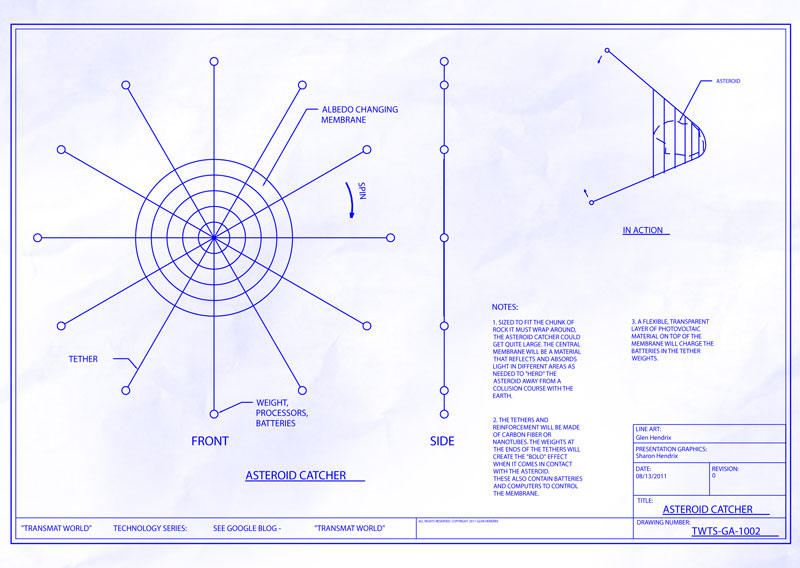
First, take one asteroid. Literally. Asteroid 2012-DA14 flew by on February 15, 2013, closer to Earth than some satellites. Imagine an interceptor launched from Earth that attaches to this space-faring boulder and guides it into an orbit around the Earth. This does two things. First, it's close enough to work on without long space flights. Secondly, we know right where it is. One less asteroid to worry about hitting Earth. As to the details of how to hijack an asteroid, a device similar to what I describe in Saving the World From an Asteroid Strike can be used. It is an OLED blanket that attaches to the asteroid and turns from flat black to a mirror surface, controlling the light pressure that hits the asteroid and, thus, its orbit. It can use that same process to control the spin of the rock by causing light pressure to change on different quadrants of the asteroid at different times. Click on the drawing below for a larger view.

Basics of an asteroid catcher.
Using light pressure might be a little slow. What may be more likely is the use of a small ion thruster powered by a miniature nuclear reactor and hooked up to a computer and an SSPS (Solar System Positioning System).

This is technologically feasible right now, and it is something we should be doing right now. Why? Because to tame the orbit of these huge rocks will take decades. This is the time we will use to develop that cheap means of orbital access so that when these big boulders begin their close orbit of Earth we can go to work on them. We will mine them for their minerals and turn the scrap into a space habitat.

TWO: 
Melt that orbital scrap heap into a molten ball and then blow it up like a glass bauble. Using inexpensive inflatable, focusable orbiting mirrors (more completely described in my post The Space Mirror Hack) the sun's energy is concentrated onto the remnants of an asteroid that's been stripped of precious metals, minerals and water. Once this detritus is melted, forming a sphere in zero gravity, a high temperature resistant metal or ceramic pipe is inserted until the end is near the center of this ball of liquid rock. An inert gas, probably nitrogen, is introduced, inflating it until we have an empty sphere with, ideally, at least 6 foot thick walls. This will protect against even the most potent of cosmic rays. With 6 foot thick walls, asteroid 2012-DA14 would provide a spherical shell with an inside diameter as big as a football field. Click on any of the following illustrations for a larger view.

An inflatable, orbital mirror

Using space mirrors to melt an asteroid

Inflating a molten asteroid
THREE:
After it cools down, the inside of this sphere can be fitted out to accommodate human habitation. Oxygen is mixed with the nitrogen inflating gas to form a breathable atmosphere. The whole thing will be be parked at a Lagrange Point and set spinning to provide artificial gravity. Several cylindrical layers will be installed to form floors to divvy up into living quarters. The metal mined from the asteroid can be turned into sheets and structural shapes for this purpose. The central area will be a weightless area used for working on space vehicles docked for loading, unloading, or repairs. The low-gravity areas are public spaces where you can rent wings and go flying under your own power. The high-gravity areas near the perimeter of the shell contain gyms and running trails to keep people in shape. In between are apartments and commercial areas.

The Space Egg - how it might look on the inside
There you have it. How to live in space in three steps. Not small, temporary things like the ISS, but large, permanent colonies in space with the clear-cut goals of taking advantage of the energy and mineral wealth to be found there. Planetary Resources, Inc. and Deep Space Industries are two companies recently created with a mission of locating and mining asteroids. Hopefully, their plans also include the capture and relocation of material to Earth orbit so it can be turned into a comfortable place to stay while those asteroids are being mined.