Showing posts with label mining asteroids. Show all posts

Monday, August 6, 2018

How We Will Get Asteroid Material Back To Earth


Tesla Roadster in space - courtesy wikipedia


We won't be hauling it down with a Tesla Roadster.


An asteroid one kilometer in diameter is parked at the Lagrange point L5 of the Earth/Moon gravitational system. The asteroid orbits the Earth at the same distance as the Moon - 238,900 miles. If a line were drawing through the center of the Earth to the Moon and the center of Earth to the asteroid there would be about a 45 degree angle between those lines. It is in a safe, stable orbit that does not require regular expenditures of fuel to keep it there. This safe, stable location was the deal between the United Nations and the company retrieving the giant space rock; actually more metal than rock. 16217 Ryugu contains iron, nickel, cobalt, water, nitrogen, hydrogen, and ammonia. 


Plastic bags are made from ethane, a part of natural gas burned as waste before they started making plastic bags. 


Outer space construction has not yet hit its stride so some cheap way is needed to get these metals to the surface of Earth where they can be sold. Here is how it could be done. 

If chunks of metal were cut off of Ryugu and simply dropped to Earth, it would be a mess. Chunks big enough not to vaporize completely upon reentry could do major damage. The velocity when it reached Earth would be nearly 200,000 miles per hour and create an explosion equivalent to 100,000 tons of TNT. So, for practicality, we need to get this stuff closer to Earth and reduce that velocity. 


Flaming mass making reentry - courtesy Neil Bleving


A deal is brokered between the powers that be on Earth and the asteroid mining company so that a million ton chunk of iron can be brought into a medium Earth orbit about 2,000 miles up with careful planning and monitoring. Along with it comes several space tugs and lots of water (from the asteroid) as fuel (electrolysis - oxygen, hydrogen) to keep it in orbit. Engines are anchored to the big asteroid chunk and will automatically kick in to prevent a deterioration in orbit. 

Any amount of heat one requires in outer space is available. One simply needs the right size mirror configured to apply that heat to an appropriately sized area on command. With this heat the stoney portions of an asteroid and, perhaps, lunar regolith can be melted and turned into ceramic. Metals can be melted down by these same mirrors. 

Concentrating mirrors cut off a 300 ton chunk of iron and begin to melt it down. 

Concurrently, stoney portions of the asteroid are melted to form ceramic. While the ceramic is molten, pre-heated (to prevent explosive expansion) nitrogen is introduced into the ceramic melt to produce a foamed ceramic material. This material will be formed into the shape of a lifting body similar to that of the Space Shuttle but about half the size.  As the hot nitrogen entrained in the ceramic cools it forms a partial vacuum, making the material much less conductive to heat. 


It takes 7 trucks to move the same number of paper bags as one truck moving plastic bags. 


The blob of iron melt is rammed into the ceramic mold. High temperature spargers inserted through the wall of the mold inject the iron with nitrogen as well, making a foamed metal having one tenth the weight of iron while still retaining much of its strength.

Once out of the mold, a foamed-ceramic mat is attached to the bottom of the foamed metal lifting body. and a steering module is inserted into the cavity molded in the rear to accept it. This is a heat-resistant rudder and elevators on vertical and horizontal stabilizers controlled by an onboard GPS and autopilot. Built in space with only the electronics and motor coming from Earth, those parts are used again while the rest is recycled. 

A railgun is built on the mass of the asteroid chunk and points at a tangent point to Earth about 100 miles above the surface. The lifting body is attached through grooves molded into it and launched towards Earth at 20,000 miles per hour retrograde to orbital velocity. When the lifting body reaches the upper atmosphere, it is going much slower in relation to the Earth, allowing a safe, guided landing on a shallow lake where it is recovered. 

The bubbled metal might be worth many times its solid value, making the whole operation profitable. Many types of metallurgy may be possible in a vacuum and weightlessness that aren’t feasible on Earth. We could be talking about metals such as high temperature inconels that are very expensive. I designed a coil in a furnace, the prototype for making BPA free plastic bottles, where a 6 inch schedule 40 (1/4” thick wall) piece of pipe cost $1200 per linear foot. 

For smaller packages of very valuable metals like platinum or palladium, NASA may have just the thing. They have developed a folding heat shield. A small reentry vessel with a hundred pounds of palladium has a heat shield that folds out to a much larger size than the vessel itself, creating a shield off of which most of the frictional heat is sloughed away around the side of the vessel on its reentry path to an elevation and speed at which it can deploy a parachute. Be there to pick it up before someone else gets it because that's 1.6 million dollars we're talking about. 


courtesy NASA


These are the possibilities once we start thinking about how to maximize the payback for such a massive undertaking as capturing an asteroid. Of course, the real payoff for the asteroid miner will be when construction off world begins, increasing the value of their asteroid many times. Unexpected returns will be the technological advances necessary to get this done that will eventually work their way into our everyday lives. 

Other articles you may enjoy:


Saturday, February 16, 2013

Living In Space - One, Two, Three

by Glen Hendrix

An early (1949) vision of space habitation from Russia


In my blog post, "The Zombification of Innovation?", I list a cheap way of getting into space as one of the tech voids waiting to be filled; something to leapfrog SpaceX and, possibly, rocket science altogether; something on the order of a space elevator. So what?, you say. There's radiation and muscle atrophy and no air in space. What's the point of a cheap way to get somewhere unless there's a viable reason to go there and at least 3 star digs when you get there?

Paper or plastic? … Are you sure? 


The thing is, we have to get into space. We have been lulled into complacency by our beautiful Earth with its wonderful radiation shielding, waving fields of grain, and the automatic up/down clues provided by gravity. It is still just a big rock. It has a volume, surface and mass that is finite. We can wear it out and use it up. Humankind doesn't like the finite. Especially when it comes to growth. If we go into space, we don't have to face the boogeyman of make-do, the spectre of want, and the real threat of contraction instead of growth.

No, I am not talking about a moon base. We'd still be stuck in a gravity well.

There is a ratio tool called EROI (energy returned on energy invested). When EROI is high like it was a century ago at the beginning of big oil (100:1), things are rosy. As EROI begins to drop, the rainbows and lollipops begin to diminish. Currently it's about 3:1 in the U.S and about 10:1 in Saudi Arabia. Let me put it another way. It took 1 barrel of oil to get 100 barrels of oil 100 years ago. Today, for the U.S., it takes 1 barrel of oil to get 3 barrels of oil. Do a graph, plot a curve, count some beads; whatever you do to visualize this, it's not good as a future trend. The price of fuel skyrockets as the ratio gets closer to 1:1.


It costs $4000 to recycle a ton of plastic bags worth $500 on the open market. 


The EROI is a very simple tool that does not take into consideration the environmental costs of energy extraction and use. Not only are we running out of convenient, inexpensive liquid fossil fuels, we are stewing in the products of combustion from those fuels. We have a choice now of settling for the finite and the limited or opting for the infinite and limitless. Going into space will transform humanity. Our EROI will go back to well over 100:1 with nearly limitless solar energy. That's why we have to go into space.

We don't know what's out there; maybe space whales.
Image courtesy of elbardo at deviantART
Another reason we should go into space is the electronic broadcast of our presence is blasting into space at the speed of light. Soon, relatively speaking, the whole galaxy will know about us. At the rate they are discovering habitable planets, it is almost a certainty there is someone out there listening. Whether they come hither is another matter, but I'm sure we will be better equipped to deal with that if we are a space-faring race by the time they get here.

Let's assume that we do have that elevator into space. At the least, let's assume we have completely re-usable rockets fueled by liquid hydrogen made cheap by fusion or some other energy breakthrough. What are the steps to make space our home sweet home?


Credit: Image credit: NASA/JPL-Caltech/UCLA/MPS/DLR/IDA

ONE:
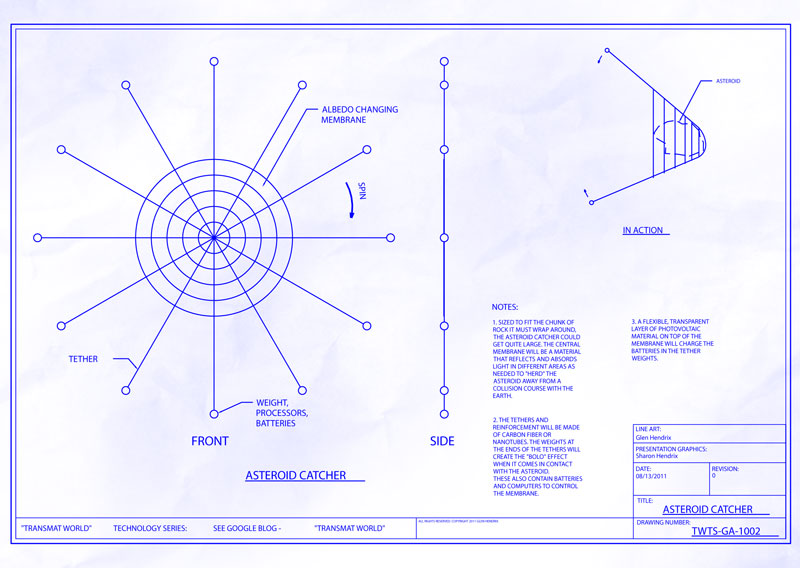
First, take one asteroid. Literally. Asteroid 2012-DA14 flew by on February 15, 2013, closer to Earth than some satellites. Imagine an interceptor launched from Earth that attaches to this space-faring boulder and guides it into an orbit around the Earth. This does two things. First, it's close enough to work on without long space flights. Secondly, we know right where it is. One less asteroid to worry about hitting Earth. As to the details of how to hijack an asteroid, a device similar to what I describe in Saving the World From an Asteroid Strike can be used. It is an OLED blanket that attaches to the asteroid and turns from flat black to a mirror surface, controlling the light pressure that hits the asteroid and, thus, its orbit. It can use that same process to control the spin of the rock by causing light pressure to change on different quadrants of the asteroid at different times. Click on the drawing below for a larger view.

Basics of an asteroid catcher.
Using light pressure might be a little slow. What may be more likely is the use of a small ion thruster powered by a miniature nuclear reactor and hooked up to a computer and an SSPS (Solar System Positioning System).

This is technologically feasible right now, and it is something we should be doing right now. Why? Because to tame the orbit of these huge rocks will take decades. This is the time we will use to develop that cheap means of orbital access so that when these big boulders begin their close orbit of Earth we can go to work on them. We will mine them for their minerals and turn the scrap into a space habitat.

TWO: 
Melt that orbital scrap heap into a molten ball and then blow it up like a glass bauble. Using inexpensive inflatable, focusable orbiting mirrors (more completely described in my post The Space Mirror Hack) the sun's energy is concentrated onto the remnants of an asteroid that's been stripped of precious metals, minerals and water. Once this detritus is melted, forming a sphere in zero gravity, a high temperature resistant metal or ceramic pipe is inserted until the end is near the center of this ball of liquid rock. An inert gas, probably nitrogen, is introduced, inflating it until we have an empty sphere with, ideally, at least 6 foot thick walls. This will protect against even the most potent of cosmic rays. With 6 foot thick walls, asteroid 2012-DA14 would provide a spherical shell with an inside diameter as big as a football field. Click on any of the following illustrations for a larger view.

An inflatable, orbital mirror

Using space mirrors to melt an asteroid

Inflating a molten asteroid
THREE:
After it cools down, the inside of this sphere can be fitted out to accommodate human habitation. Oxygen is mixed with the nitrogen inflating gas to form a breathable atmosphere. The whole thing will be be parked at a Lagrange Point and set spinning to provide artificial gravity. Several cylindrical layers will be installed to form floors to divvy up into living quarters. The metal mined from the asteroid can be turned into sheets and structural shapes for this purpose. The central area will be a weightless area used for working on space vehicles docked for loading, unloading, or repairs. The low-gravity areas are public spaces where you can rent wings and go flying under your own power. The high-gravity areas near the perimeter of the shell contain gyms and running trails to keep people in shape. In between are apartments and commercial areas.

The Space Egg - how it might look on the inside
There you have it. How to live in space in three steps. Not small, temporary things like the ISS, but large, permanent colonies in space with the clear-cut goals of taking advantage of the energy and mineral wealth to be found there. Planetary Resources, Inc. and Deep Space Industries are two companies recently created with a mission of locating and mining asteroids. Hopefully, their plans also include the capture and relocation of material to Earth orbit so it can be turned into a comfortable place to stay while those asteroids are being mined.