Showing posts with label SpaceX. Show all posts

Friday, November 2, 2018

The Technology of Fresh Food In Outer Space


Crops inside a Mars Lunar Greenhouse unit.
 Courtesy Dave Mosher/Business Insider


I've talked to you about picking the right asteroid, how to securely land on it, the equipment you'll need to mine it, how to give it a propulsion system that could last for centuries, and recycling the mined out asteroid into a Solar System traversing space yacht. 


Saving the world one plastic grocery bag at a time. Recycling genius.  


What I haven’t talked about is when you and your friends are sitting in the lounge of that space yacht halfway to Ceres, laughing at old Lost in Space episodes, and you get the munchies, and you want something fresh; not frozen, dried, jerked, or canned. This is not a mundane or unreasonable request. The human palate sometimes demands fresh fruits or vegetables to be satisfied, and it may be some time before a true replicator comes along that can actually build something organic, molecule by molecule, and get it right. 


Mars colony with modules. Courtesy NASA


Man cannot live on Tang and freeze-dried ice cream alone, so being able to grow food will be a necessary thing for staying on Mars or the Moon for any length of time. While the ability to grow fresh produce is a great asset for cruising to the asteroid belt on your space yacht, for long term residents of Mars it is essential. It will serve as a buffer for the cataclysmic accidents we are already familiar with in space travel. It’s a dangerous business. A lost supply ship could mean starvation to the Mars crew unless they are at least semi self sufficient.

What are the current options? Near the top of the list would be the Mars-Lunar Greenhouse. It is a bioregenerative system, meaning it's self-sustaining for the plants, animals, and microorganisms living in it. After an administration change, NASA’s study of bioregenerative life support systems took a big hit in funding. It shut down the project in 2003 but managed to funnel some grant money to the University of Arizona to study the feasibility of a greenhouse that would produce food, oxygen, and process grey water - all helpful things in space. 


A prototype of the Mars Lunar Greenhouse, a bioregenerative life support system funded in part by NASA. Courtesy University of Arizona.


They came up with a collapsible aluminum and plastic tube 7 feet in diameter and 18 feet long that telescopes down to 4 feet for shipping. Plastic tubes supply water to plant roots. Light comes from an LED system or is piped in from the outside. There is an external composter that digests human and plant waste with microbes and filters water. One of these units, under optimal operating conditions, can provide 50% of food, 100% of air, and 100% of clean water that one astronaut needs on Mars or the Moon. 

It is not perfected, and the money for the project ran out in 2017. The Chinese have a similar project under way. It is much further along. Eight Chinese student volunteers spent a year in China's "Lunar Palace 1", the longest stay in a self-contained facility. Their stay ended in May of 2018. The Chinese are planning to go back to the Moon as well If they can get their fusion technology perfected, the helium-3 on the Moon could be a game changer for energy domination.


Although the Mars Lunar Greenhouse is a wonderful thing, it seems a similar setup could be made using an aeroponic system. SpaceX has not said anything about developing a bioregenerative unit for its planned Mars mission. Thawed bologna sandwiches without lettuce and tomatoes for that crew so far. It seems the opportunities in this field for companies to develop support technology are many and varied. It’s need is a given for space, but there may be applications on Earth. Some people may feel their survival bunkers just aren’t complete without a self-contained bioregenerative greenhouse. 

The fresh greens and fruit aren’t quite ready for prime time but what about meat? I just can’t picture giant links of sausage hanging/floating from the instrument packages on the Big Falcon Rocket Spaceship like a science fiction-tweaked scene from Das Boot. Probably there will be a tabletop version of the machinery used by Impossible Foods to make their hamburgers from yeast. Their tech is to get yeast to produce the iron-infused chemical heme that gives meat its distinctive flavor.  

Also, real meat can be grown from muscle tissue stem cells, forming something that looks and tastes like meat. Professor Mark Post of Maastricht University gave a demonstrative proof-of-concept to "cultured" meat in 2013, but no attempts have been made to scale it up commercially. There are misgivings about public acceptance. This is a very promising technology for adaptation to space travel and long-term stays on Mars and the Moon. The commercial aspects for Earth-bound populations should also be re-visited in light of the increasing certainty of an agriculture/climate relationship.

At the rate technology is moving now, there is a good chance efficient greenhouses and miniature meat labs will provide fresh food to those venturing beyond the Earth's gravity well by the time we get ready to send them. So don't turn down that astronaut gig because of preconceptions about a boring diet in space. Chasing your shrimp salad down in zero g, on the other hand, is a totally different matter for consideration. 


Monday, October 29, 2018

Going Back To the Moon Is Not Just For Governments Anymore


The MX-9 Frontier Class Explorer. Courtesy Moon Express


The first U.S. craft back to the Moon's surface may not be the government's. It may well be a corporate endeavor. Moon Express has been given permission by the U.S. government to land a craft on the Moon. The Space Resources and Utilization Act of 2015 allows private corporations to go out and mine the asteroids and the Moon while still adhering to the Outer Space Treaty of 1967.

NASA cancelled its Resource Prospector project in April of 2018. This is after spending $100 million dollars and over a decade on it and the program it evolved from - RESOLVE. Resource Prospector was a rover with instruments and tools for locating ice and minerals on the Moon. Now NASA has said it wants private industry to not only provide the lunar rover but transportation for it to the Moon and back. 


The MX-1 Scout Class Explorer. Courtesy Moon Express.


1. Lunar Scout will be the first commercial voyage to the Moon, delivering about 30 kg of instruments to the lunar surface. This is mainly a proof of design mission.

2. Lunar Outpost is similar to Scout but will head for the southern pole of the moon and prospect for water and minerals.

3. Harvest Moon will send a larger assembly  to collect samples and return them to orbit where they will dock with transport back to Earth.


Scrapped Lunar rover Resource Prospector - courtesy NASA


The philosophy of Moon Express is that the Moon is an 8th continent to be explored and surveyed for the possibility of economical benefits to mankind. Known minerals and metals are magnesium, aluminum, silicon, iron, and titanium. Also important are the location and quantification of helium-3 and water ice. These two could easily become the economic foundation for a settlement on the Moon, launching material into orbit for use in space or a trip back to Earth. 

Saving the world one plastic bag at a time. Recycling genius. 


While SpaceX is talking about sending tourists around the Moon, Moon Express is planning on going back to the surface of the Moon with the ultimate goal of exploiting the Moon for its resources. This could help out Elon’s plans to go to Mars by providing relatively cheap fuel (electrolyzed water into oxygen and hydrogen) that can be used to refuel SpaceX’s Big Falcon Rocket for the journey. 


Courtesy NASA


It also fits into plans NASA has for a space station, Lunar Orbital Platform-Gateway, orbiting the Moon and acting as a depot for deep space craft and headquarters for Moon surface activity. NASA is currently seeking ideas for commercial uses of this lunar orbiting space station. Perhaps as the realization sinks in that it is not just asteroids but the Moon as well that is up for grabs, more companies will come up with ideas on how to carry that out quickly and inexpensively. 

Other articles you may enjoy:


Monday, October 8, 2018

A Safer, More Luxurious Alternative to Currently Planned Mars Missions


Hyabusa2, Japanese space craft sent to explore Ryugu


The asteroid Ryugu comes relatively close to Earth twenty seven times before the end of the century. It also comes close to the orbit of Mars on its journey around the Sun. Some of those orbits will include both a close encounter with Earth and with Mars. According to the web site Asterank, on December 29, 2020, Ryugu comes very close to Earth, relatively speaking. It will be 0.061 AU, about 5.7 million miles, away. It will be even closer on December 21, 2033; a scant 4.4 million miles. These distances are 6 to 8 times closer than 36 million miles, which is the closest Mars gets to Earth, and a hundred times closer than 400 million miles, the farthest point. 

Orbits Ryugu, Mercury, Venus, Earth, Mars

What if we intercept Ryugu with autonomous drones towing the equipment necessary to mine Ryugu for some of the $83 billion dollars worth of nickel, iron, cobalt, water, and frozen gasses that it contains? This equipment is set up, solar panel arrays are unfolded and activated, and the asteroid swarms with prospector drones cataloging material and locations. All this takes place as the asteroid proceeds in its orbit about the Sun. It will be quite busy until a suitable load of material is collected and secured for a trip back when the asteroid comes close to Earth again. 

Plastic grocery bags prefer this as their second career. 


What if the holes and tunnels the mining drones excavate for ore are repurposed as living quarters for astronauts to hitch a ride to Mars, do a year or three of studies, and then hitch a ride back? That presupposes a workable spacecraft that can land on Mars and take off again after sitting months, possibly years, on the surface of Mars and be attached or otherwise stowed on our shuttle asteroid. Does this idea sound any more incredible than a ship that will do that plus make the journey from Earth to Mars while keeping passengers safe from radiation, bone loss, and well fed? Besides that, it would be there for future missions for hundreds of years into the future; a permanent, luxury shuttle to Mars and back. 

Ryugu; an asteroid about a kilometer in diameter.


A hollowed out asteroid could haul power, water mining, food growing, and shelter building equipment packaged in appropriate landers to Mars orbit. The asteroid shuttle could even be spun up to provide artificial gravity to minimize bone loss over the course of the journey.  A deep space tug stowed on the asteroid would drag this equipment from the asteroid to an orbit around Mars for insertion and landing. Autonomous robots could begin setting up camp, so to speak, getting ready for the human occupation. 

On the next trip, the asteroid shuttle will carry a vehicle with the ability to orbit Mars, land, and take off. Along with that vehicle will be the first people, a cherry-picked group of scientist explorers. With so much of their survival equipment already in place, the first humans on Mars will have much more time to devote to science rather than just staying alive. The asteroid itself would lend itself to a great lab for deep space, vacuum, and microgravity experiments. A good telescope would be included for closer looks at denizens of the asteroid belt.

Use those plastic grocery bags again. Save money. Save the world. Here’s how. 


This is pretty much the same scheme Elon Musk proposes, a two-part trip using the Big Falcon Rocket. Two BFRs locate water and deliver equipment in 2022. A second pair of crewed BFRs plus two drone cargo BFRs, in 2024, deliver more equipment and  the astronauts. 

NASA’s version of the Mars mission depends on the development of a Deep Space Gateway, DSG, sort of a mini-ISS orbiting the Moon. A Deep Space Transport, DST, would be NASA’s answer to SpaceX’s BFR.

Even if it were decided to use an asteroid as a shuttle to Mars, the BFR or the launch system for the DST would still have to be developed and used to get the bigger pieces of equipment into orbit for the mission. From there the BFR, DST, or a space tug would ferry the equipment to the asteroid at its closest approach to Earth. If the space tug is used, it would free up the BFRs to be loaded with some of the more expensive metals mined from the asteroid and haul that back to the Earth’s surface. Everybody wins! The Mars explorers would get there more safely and in much more comfortable quarters. Elon Musk makes money hauling exploration equipment into space and asteroid material down to Earth. The only musical chairs loser might be the DST, which is basically a deep space ferry similar to the space tug. But there definitely is still a need for this type of vehicle, and it may very well be used in conjunction with the BFR for the role of role of deep space tug. It may be better suited for that purpose than the BFR because a large portion of its capacity is not given over to reentry shields and landing engines as in the BFR. 

There are many asteroids that swing close to Earth on a periodic basis before making their journey around the Sun. They go to many places we would like to explore. It's a bevy of safe, durable, long-lasting shuttles to and from the extremities of the asteroid belt to the inner planets. We should take advantage of them. 

The exploration of space is a juggle of restraints put in place by the physical laws of our universe. In the end we must make a decision on how it will be done. Hopefully, that decision will be made with the safety of the crew uppermost in mind. Using an asteroid to make the journey to Mars and back sounds, on paper at least, like a safe, comfortable, less expensive route to take. It very much depends on how quickly and intelligently the asteroid mining industry advances over the next few years. 

Other articles you may enjoy:


Saturday, February 16, 2013

Living In Space - One, Two, Three

by Glen Hendrix

An early (1949) vision of space habitation from Russia


In my blog post, "The Zombification of Innovation?", I list a cheap way of getting into space as one of the tech voids waiting to be filled; something to leapfrog SpaceX and, possibly, rocket science altogether; something on the order of a space elevator. So what?, you say. There's radiation and muscle atrophy and no air in space. What's the point of a cheap way to get somewhere unless there's a viable reason to go there and at least 3 star digs when you get there?

Paper or plastic? … Are you sure? 


The thing is, we have to get into space. We have been lulled into complacency by our beautiful Earth with its wonderful radiation shielding, waving fields of grain, and the automatic up/down clues provided by gravity. It is still just a big rock. It has a volume, surface and mass that is finite. We can wear it out and use it up. Humankind doesn't like the finite. Especially when it comes to growth. If we go into space, we don't have to face the boogeyman of make-do, the spectre of want, and the real threat of contraction instead of growth.

No, I am not talking about a moon base. We'd still be stuck in a gravity well.

There is a ratio tool called EROI (energy returned on energy invested). When EROI is high like it was a century ago at the beginning of big oil (100:1), things are rosy. As EROI begins to drop, the rainbows and lollipops begin to diminish. Currently it's about 3:1 in the U.S and about 10:1 in Saudi Arabia. Let me put it another way. It took 1 barrel of oil to get 100 barrels of oil 100 years ago. Today, for the U.S., it takes 1 barrel of oil to get 3 barrels of oil. Do a graph, plot a curve, count some beads; whatever you do to visualize this, it's not good as a future trend. The price of fuel skyrockets as the ratio gets closer to 1:1.


It costs $4000 to recycle a ton of plastic bags worth $500 on the open market. 


The EROI is a very simple tool that does not take into consideration the environmental costs of energy extraction and use. Not only are we running out of convenient, inexpensive liquid fossil fuels, we are stewing in the products of combustion from those fuels. We have a choice now of settling for the finite and the limited or opting for the infinite and limitless. Going into space will transform humanity. Our EROI will go back to well over 100:1 with nearly limitless solar energy. That's why we have to go into space.

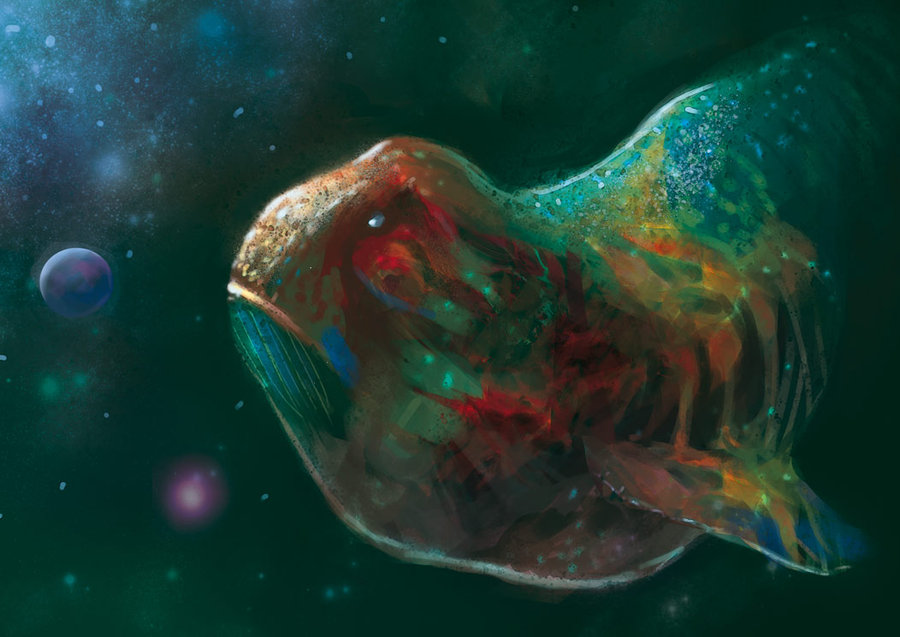
We don't know what's out there; maybe space whales.
Image courtesy of elbardo at deviantART
Another reason we should go into space is the electronic broadcast of our presence is blasting into space at the speed of light. Soon, relatively speaking, the whole galaxy will know about us. At the rate they are discovering habitable planets, it is almost a certainty there is someone out there listening. Whether they come hither is another matter, but I'm sure we will be better equipped to deal with that if we are a space-faring race by the time they get here.

Let's assume that we do have that elevator into space. At the least, let's assume we have completely re-usable rockets fueled by liquid hydrogen made cheap by fusion or some other energy breakthrough. What are the steps to make space our home sweet home?


Credit: Image credit: NASA/JPL-Caltech/UCLA/MPS/DLR/IDA

ONE:
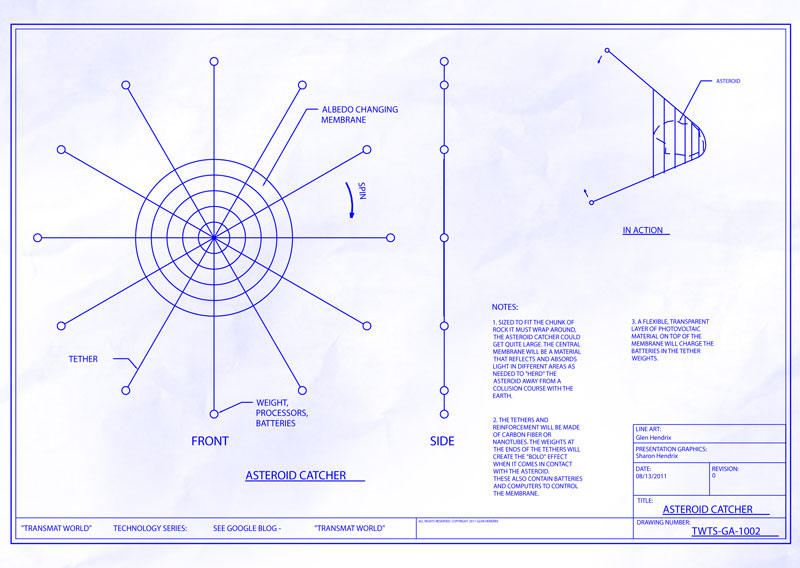
First, take one asteroid. Literally. Asteroid 2012-DA14 flew by on February 15, 2013, closer to Earth than some satellites. Imagine an interceptor launched from Earth that attaches to this space-faring boulder and guides it into an orbit around the Earth. This does two things. First, it's close enough to work on without long space flights. Secondly, we know right where it is. One less asteroid to worry about hitting Earth. As to the details of how to hijack an asteroid, a device similar to what I describe in Saving the World From an Asteroid Strike can be used. It is an OLED blanket that attaches to the asteroid and turns from flat black to a mirror surface, controlling the light pressure that hits the asteroid and, thus, its orbit. It can use that same process to control the spin of the rock by causing light pressure to change on different quadrants of the asteroid at different times. Click on the drawing below for a larger view.

Basics of an asteroid catcher.
Using light pressure might be a little slow. What may be more likely is the use of a small ion thruster powered by a miniature nuclear reactor and hooked up to a computer and an SSPS (Solar System Positioning System).

This is technologically feasible right now, and it is something we should be doing right now. Why? Because to tame the orbit of these huge rocks will take decades. This is the time we will use to develop that cheap means of orbital access so that when these big boulders begin their close orbit of Earth we can go to work on them. We will mine them for their minerals and turn the scrap into a space habitat.

TWO: 
Melt that orbital scrap heap into a molten ball and then blow it up like a glass bauble. Using inexpensive inflatable, focusable orbiting mirrors (more completely described in my post The Space Mirror Hack) the sun's energy is concentrated onto the remnants of an asteroid that's been stripped of precious metals, minerals and water. Once this detritus is melted, forming a sphere in zero gravity, a high temperature resistant metal or ceramic pipe is inserted until the end is near the center of this ball of liquid rock. An inert gas, probably nitrogen, is introduced, inflating it until we have an empty sphere with, ideally, at least 6 foot thick walls. This will protect against even the most potent of cosmic rays. With 6 foot thick walls, asteroid 2012-DA14 would provide a spherical shell with an inside diameter as big as a football field. Click on any of the following illustrations for a larger view.

An inflatable, orbital mirror

Using space mirrors to melt an asteroid

Inflating a molten asteroid
THREE:
After it cools down, the inside of this sphere can be fitted out to accommodate human habitation. Oxygen is mixed with the nitrogen inflating gas to form a breathable atmosphere. The whole thing will be be parked at a Lagrange Point and set spinning to provide artificial gravity. Several cylindrical layers will be installed to form floors to divvy up into living quarters. The metal mined from the asteroid can be turned into sheets and structural shapes for this purpose. The central area will be a weightless area used for working on space vehicles docked for loading, unloading, or repairs. The low-gravity areas are public spaces where you can rent wings and go flying under your own power. The high-gravity areas near the perimeter of the shell contain gyms and running trails to keep people in shape. In between are apartments and commercial areas.

The Space Egg - how it might look on the inside
There you have it. How to live in space in three steps. Not small, temporary things like the ISS, but large, permanent colonies in space with the clear-cut goals of taking advantage of the energy and mineral wealth to be found there. Planetary Resources, Inc. and Deep Space Industries are two companies recently created with a mission of locating and mining asteroids. Hopefully, their plans also include the capture and relocation of material to Earth orbit so it can be turned into a comfortable place to stay while those asteroids are being mined.


Friday, October 28, 2011

Solution to the Problem of Orbital Debris

image of space debris courtesy Wikilimages
An article in Universe Today points out that space debris is a huge problem. The retired head of NASA’s Orbital Debris Program Office, Donald Kessler, wrote a report on this describing the situation as bad and getting worse. Mr. Kessler originally predicted the scenario of orbital litter becoming a major problem for the advancement of the space program and a danger to satellites back in 1976. The situation he described has come to pass and is appropriately designated the Kessler Syndrome. 
A report from NASA makes two conclusions:

1. “The  current debris population in the LEO region has reached the point where the environment is unstable and collisions will become the most dominant debris generating mechanism in the future.”

2. “Only remediation of the near-Earth environment – the removal of existing large objects from orbit – can prevent future problems for research in and commercialization of space.”

Active Debris Removal (ADR) is recommended by NASA. A proposed solution to this problem is advanced in this article from Wired Science. It may have merit but it represents a lot of money to be spent just to see if it works. This is where the Space Mirror steps in to save the day.

My original Space Mirror concept (drawing shown) can be scaled up easily to perform the task of getting rid of orbital space debris. The Space Mirror consists of two disc-shaped membranes of sheet plastic approximately 8 mils thick. These are jam-up, jelly-tight next to each other. They are 1000 feet in diameter and keep their shape via an inner-tube-shaped, inflated toroid with a sectional diameter of 10 feet. The circular edges of these membranes are attached by airtight seal to the inside radius of the toroid. One of the membranes is transparent and and the other is mirrored on the inside surface. When gas is introduced between them they expand, deforming into spherical surfaces capable of focusing the sun’s rays on a small area. The focal length ranges from about a mile to almost 5,000 miles. A unit containing gas cylinders, computers, radar, and solar panels attached by a flexible umbilical provides the essentials for directing and focusing the mirror. The radar and other sensors work with the computer to fire small thrusters around the outer surface of the tubular frame keeping the device aimed and in the proper orbit. Small, semi-autonomous robots roam the cavities of the framing tube and the surfaces of the membranes looking for and repairing small punctures. It sounds like a big thing but it all folds up for one payload in the new spacecraft from SpaceX, the Falcon Heavy.


It takes 7 trucks to move the same number of paper bags as one truck moving plastic bags. 


This device was originally devised to facilitate the construction of space habitats, melting captured asteroids or meteors and then inflating them to create habitable spaces. Recently, other applications have come to mind. With its ability to direct and focus large amounts of energy, it makes a perfect mechanism to sweep from the littered skies of Earth the small debris that will eventually inhibit exploration of space and utilization of near-Earth orbits. It will simply focus the sun’s energy on these objects and they will vaporize. If you doubt this, look at the results of using just 22 square feet of concentrated sunlight. It will melt steel and even rock. Now imagine 800,000 square feet of sunlight (over 36,000 times that power) concentrated on a small area. Now double that energy because sunlight is twice as strong in space, unhindered by atmosphere. Material would not only melt, it would become a cloud of vapor almost instantly - exactly what you want orbital space debris to do. Another great thing about this concept is that it can be tested right here on the surface before installing it in orbit.

Debris strike simulation.


The 1500 pieces of large debris can also be taken care of by selectively zapping them, causing explosive reactions to decelerate them and bring them down to burn up in the Earth's atmosphere.
These represent 98% of space debris by mass and it is feared collisions between them will cause an increase in the threat of orbital debris to mankind's space aspirations.


The answer to the plastic bag problem is reuse. This new device makes it easy. 


Due to the implications for military applications, the Space Mirror would have to be an international effort, controlled by a committee made up by representatives of countries investing in the project. It could be set up for a specified period of time to do its job of cleaning debris from orbit and then be decommissioned. It is something that needs to be seriously considered if mankind is to advance into the frontier of space without tripping over its own trash.

Thanks,
Glen Hendrix
Look for my scifi novel Transmat World at Amazon.com


Saturday, August 6, 2011

Saving the World From an Asteroid Strike

Device for wrapping an asteroid with "smart film"


Headlines read “ASTEROID ON COLLISION COURSE WITH EARTH!” Before people start forming cults and building underground shelters, the government comes on all network channels to allay everyone’s fears. A spacecraft is on its way to fix the problem.

Asteroid
What do they have on that spacecraft: an atomic bomb, a strap-on rocket, a powerful laser, or Bruce Willis and his crew? No, they have “smart film.” Huh? You heard what I said, "Smart film." I mention this device in my book Transmat World where it is used to steer slugs of lunar regolith into position in orbit around the Moon. In the book, it is already wrapped around its payload before it is launched from the Moon’s surface - very neat, very efficient. Once in orbit, this film covering the load changes its albedo selectively from black to a mirror finish on different parts of the load to “herd” it into its proper position using the pressure of photons from the sun. Remember those transparent globes with what looked like two little diagonal flags on a spindle in the middle from physics class. When you held it up to the light the little flags would spin around. Well, if you were paying attention, you would know that one flag was mirrored and the other was matte black. Photons were absorbed by the black flag and reflected by the mirrored flag. That is what spun it around. Same principle here.

It will be a little more difficult getting this smart film onto the surface of an approaching asteroid. Our NASA or SpaceX spacecraft has delivered a payload that is now approaching the asteroid. The payload begins to spin about its longitudinal axis. The outer panels come off. Twelve or more weights on tethers begin to spool out from the payload. At some point the outer edges of the smart film begin to appear and spread in a circular geometry. The tethers run all the way to the center of the circle of smart film. Likewise, a strand of the same stout material runs around the perimeter of the film and at intermediate points resembling a spider web in structure. This is to keep the more fragile smart film intact as it engages and wraps around the asteroid. The weights on their tethers act much as the bolas used by South American gauchos. As they wrap around their target, they become entangled and hold the smart film in place around the asteroid.
Asteroid strike.

This is and is not a far-fetched scenario. Here’s why it is. Because of its simplicity of construction, we will custom construct this device to match the size of the asteroid. We will know the direction of rotation of the asteroid and how fast it is going, so the payload will rotate accordingly. We can simulate the contact sequence to figure out how long the tethers must be to properly engage and fasten the smart film to the asteroid. Let’s now get on to the hard part--the film itself.

At this point in our technology, it would most likely be similar to an OLED; organic light-emitting diode. This OLED would be sprayed onto a flexible substrate and attached to an absolute paucity of chips to do the job it needs to do. In fact, a roll-up TV just debuted at the annual CES show. We may soon have the technology to send a 3D printer that converts the asteroid material into the film and crawls around the asteroid, mining material and laying down film. Or the asteroid could be sprayed with a substance that hardens into a film as the spacecraft sprayer circles the errant rock. There are several feasible schemes for covering the asteroid with an OLED-type film. The circuitry controlling the film will include some kind of inertial solar system guidance system and sensors to tell the film where to absorb light and where to reflect light in order to guide the asteroid away from its collision course with Earth. The Earth is saved! Thank you! Thank you! Please quiet down; there’s more. Here's why it is a far-fetched idea. You thought I'd forgotten. The force of photons on the dark areas of the film may not be enough to stop the rotation of a massive asteroid or nudge it out of the way in time to save the Earth from immediate disaster. That is why we need more vigilance in detecting far ahead of time those objects that could be dangerous, giving us the time for a scheme like this to work.

We will, or at least should, have this technology developed before it is needed. Humankind’s demands on Earth for raw materials will eventually outstrip the Earth’s ability to deliver. With this technology we can send out these intelligent tarps to round up material in our solar system and bring it back to orbit around the Earth where it can be more easily accessed. It beats the heck out of lugging mining equipment all the way to the asteroid belt to look for stuff, mine it, then transport it back--expensive and risky. It will wind up being one of the simple tools for the complicated job of keeping mankind from going the way of the dinosaur.

Not only can this device go get material from space, it may be the tool to allow us keep our access to space. Unfortunately, space debris has become a serious impediment to the future of all space programs. Particularly troublesome are the large pieces. These range from rocket parts to defunct satellites. You can't just blow them apart because that just creates more debris. The ideal solution is to bring them down to burn up in the Earth's atmosphere. This type of application is where smart film shines. Fifteen thousand objects weighing more than 220 pounds make up 98% of space debris by mass. There is a fear of these objects colliding and breaking into smaller pieces. SpaceX's new spacecraft, the Falcon Heavy, is scheduled to launch this year. With a payload of 117,000 pounds it could carry a swarm of miniature smart film modules into space to take down the most serious of these orbital debris problems at the rate of about 250 pieces per launch. Six launches, the number of manned lunar missions, would eliminate 98% of space junk.

Meteor Crater in Arizona
For one of the most well-researched, vivid, and exciting depictions of an asteroid strike that you will ever read try the epilogue of Transmat World