Showing posts with label Elon Musk. Show all posts

Monday, October 8, 2018

A Safer, More Luxurious Alternative to Currently Planned Mars Missions


Hyabusa2, Japanese space craft sent to explore Ryugu


The asteroid Ryugu comes relatively close to Earth twenty seven times before the end of the century. It also comes close to the orbit of Mars on its journey around the Sun. Some of those orbits will include both a close encounter with Earth and with Mars. According to the web site Asterank, on December 29, 2020, Ryugu comes very close to Earth, relatively speaking. It will be 0.061 AU, about 5.7 million miles, away. It will be even closer on December 21, 2033; a scant 4.4 million miles. These distances are 6 to 8 times closer than 36 million miles, which is the closest Mars gets to Earth, and a hundred times closer than 400 million miles, the farthest point. 

Orbits Ryugu, Mercury, Venus, Earth, Mars

What if we intercept Ryugu with autonomous drones towing the equipment necessary to mine Ryugu for some of the $83 billion dollars worth of nickel, iron, cobalt, water, and frozen gasses that it contains? This equipment is set up, solar panel arrays are unfolded and activated, and the asteroid swarms with prospector drones cataloging material and locations. All this takes place as the asteroid proceeds in its orbit about the Sun. It will be quite busy until a suitable load of material is collected and secured for a trip back when the asteroid comes close to Earth again. 

Plastic grocery bags prefer this as their second career. 


What if the holes and tunnels the mining drones excavate for ore are repurposed as living quarters for astronauts to hitch a ride to Mars, do a year or three of studies, and then hitch a ride back? That presupposes a workable spacecraft that can land on Mars and take off again after sitting months, possibly years, on the surface of Mars and be attached or otherwise stowed on our shuttle asteroid. Does this idea sound any more incredible than a ship that will do that plus make the journey from Earth to Mars while keeping passengers safe from radiation, bone loss, and well fed? Besides that, it would be there for future missions for hundreds of years into the future; a permanent, luxury shuttle to Mars and back. 

Ryugu; an asteroid about a kilometer in diameter.


A hollowed out asteroid could haul power, water mining, food growing, and shelter building equipment packaged in appropriate landers to Mars orbit. The asteroid shuttle could even be spun up to provide artificial gravity to minimize bone loss over the course of the journey.  A deep space tug stowed on the asteroid would drag this equipment from the asteroid to an orbit around Mars for insertion and landing. Autonomous robots could begin setting up camp, so to speak, getting ready for the human occupation. 

On the next trip, the asteroid shuttle will carry a vehicle with the ability to orbit Mars, land, and take off. Along with that vehicle will be the first people, a cherry-picked group of scientist explorers. With so much of their survival equipment already in place, the first humans on Mars will have much more time to devote to science rather than just staying alive. The asteroid itself would lend itself to a great lab for deep space, vacuum, and microgravity experiments. A good telescope would be included for closer looks at denizens of the asteroid belt.

Use those plastic grocery bags again. Save money. Save the world. Here’s how. 


This is pretty much the same scheme Elon Musk proposes, a two-part trip using the Big Falcon Rocket. Two BFRs locate water and deliver equipment in 2022. A second pair of crewed BFRs plus two drone cargo BFRs, in 2024, deliver more equipment and  the astronauts. 

NASA’s version of the Mars mission depends on the development of a Deep Space Gateway, DSG, sort of a mini-ISS orbiting the Moon. A Deep Space Transport, DST, would be NASA’s answer to SpaceX’s BFR.

Even if it were decided to use an asteroid as a shuttle to Mars, the BFR or the launch system for the DST would still have to be developed and used to get the bigger pieces of equipment into orbit for the mission. From there the BFR, DST, or a space tug would ferry the equipment to the asteroid at its closest approach to Earth. If the space tug is used, it would free up the BFRs to be loaded with some of the more expensive metals mined from the asteroid and haul that back to the Earth’s surface. Everybody wins! The Mars explorers would get there more safely and in much more comfortable quarters. Elon Musk makes money hauling exploration equipment into space and asteroid material down to Earth. The only musical chairs loser might be the DST, which is basically a deep space ferry similar to the space tug. But there definitely is still a need for this type of vehicle, and it may very well be used in conjunction with the BFR for the role of role of deep space tug. It may be better suited for that purpose than the BFR because a large portion of its capacity is not given over to reentry shields and landing engines as in the BFR. 

There are many asteroids that swing close to Earth on a periodic basis before making their journey around the Sun. They go to many places we would like to explore. It's a bevy of safe, durable, long-lasting shuttles to and from the extremities of the asteroid belt to the inner planets. We should take advantage of them. 

The exploration of space is a juggle of restraints put in place by the physical laws of our universe. In the end we must make a decision on how it will be done. Hopefully, that decision will be made with the safety of the crew uppermost in mind. Using an asteroid to make the journey to Mars and back sounds, on paper at least, like a safe, comfortable, less expensive route to take. It very much depends on how quickly and intelligently the asteroid mining industry advances over the next few years. 

Other articles you may enjoy:



Saturday, November 25, 2017

We Will Live on the Moon: the How and Why

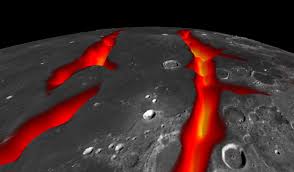
There has been some interest on the internet lately about lava tubes on the Moon. These have been known about for some years, but there hasn't been enough said about what this means to us as a supposedly intelligent race of beings on the cusp of becoming a spacefaring civilization. It brings a focus on the Moon as a candidate for a jumping-off station to the rest of the Solar System and beyond.


For the cost of 4 macchiatos you can have plastic trash bags for life.


Two separate studies of the Moon have identified ideal places for a lunar colony. In 2011, NASA's Gravity Recovery and Interior Laboratory, also known as GRAIL, consisting of two spacecraft, Ebb and Flow, mapped the gravitational field of the Moon in great detail. In 2007, the Japanese space agency, JAXA, used the spacecraft Kaguya, to map the Moon from orbit using a magnetometer, radar, and imaging instruments.

Fig. 1 
The Ebb and Flow spacecraft from the
NASA project GRAIL

Fig. 2 
Kayuga spacecraft from the Japanese
space agency JAXA

What they discovered was the presence of ancient lava tubes beneath the surface of the Moon. Thirty miles long; 340 feet wide; and, by some accounts, 3000 feet tall. There may be many such underground caverns on the moon.

Fig. 3 Artist's interpretation of the active
volcanism that create lava tubes and
pit craters or sinkholes.

Fig. 4 Pit holes or sinkholes are collapsed roofs
of lava tubes. About two hundred have
been found on the Moon.

Fig. 5 String of pits
following a lava tube.

Besides being excellent candidates for collection sites of lunar ice, these would provide protection from the -298 to +224 degrees Fahrenheit swings of temperature found on the surface of the Moon. Protection from radiation is another important consideration. We take it for granted, but the Earth with its electromagnetic force field and atmosphere protects us from ionizing radiation coming from the depths of space. Cosmic rays are strong enough to rip apart atoms in human genetic material, making cancer and mutations much more likely. Radiation storms from solar flares can cause so much damage to unprotected human tissue that sickness or death are very likely. Radiation can also play havoc with electronics that are not properly protected: thus, the protracted angst concerning the possibility of a nuclear weapon in orbit that, if exploded there, could take out a continent-sized swath of Gameboys and iPhones. Civilization would be doomed.

Fig. 6 Illustration of the formation of a lava tube on the Moon.

It takes 4" of lead, 10" of steel, 24" of concrete, or 36" of packed dirt to properly shield humans from radiation. Now you get an inkling of how difficult the trip to Mars in a space ship is going to be. Can you imagine the fuel required to move a spaceship made of 10" steel plate? Of course, it will just be a small emergency room lined with special radiation absorbing plastic, but it is still extra weight. So, to find a radiation shelter ready-made on the Moon is amazingly wonderful news. The perfect hideaway for a lunar colony. But why? I mean why a colony on the Moon?

Plastic grocery bags prefer this as their second career.


Mankind is at a dangerous juncture. There is a real threat of the planet running low on critical resources. Climate change may be worse than we think. A super volcano could erupt. An asteroid could strike. A super-flu virus 3 times worse than the 1918 flu pandemic could decimate humankind. Therefore, we need a permanent, self-reliant human presence in space to carry on should any of these things take mankind back to neolithic levels of technology.

But impending doom is apparently not a good impetus for the human race to do anything. Even with all that stuff going on, a lunar colony is not going to happen if there is not money or its equivalent in the game. Good old greed is what we need to set the wheels in motion for a colony on the Moon. So, what is on the Moon that is worth us going back to it, sprucing up one of these lava tubes, and sitting around the metaphorical campfire in the cave feeling smug about finally being in space on a permanent basis?

Great way to carry your groceries; + trash, dirty clothes, food prep waste, garden clippings, etc.


As everyone knows, nuclear fusion will be a reality in 20 years. Ahahahahahaha! No, really. It could be. It's very close now. Helium-3 can make nuclear fusion much more efficient and eliminate nuclear waste and radiation. Several governments have plans to mine the Moon for helium-3 to facilitate nuclear fusion. Based on how much energy it would produce, it is worth about $3 billion dollars per metric ton. There is an estimated 1,100,000 metric tons trapped in lunar soil. That is $3,300,000,000,000,000. It would have to be cooked out of the regolith at 1100 degrees Fahrenheit, so the lava tube would make an excellent location for a helium-3 processing plant.

Fig. 7 Inside the Alcator C-mod tokamak 
used in nuclear fusion research.

Other elements in relative abundance are oxygen, aluminum, calcium, titanium, silica, and iron. You might think these would not be for export (except, maybe, the titanium and the oxygen), and that they would mainly go toward helping build the lunar colony. They would, but think of the possibilities. Titanium, aluminum, and iron (used to make high-grade steel) in combination with 3D printers that print with even high-temperature metal will make the Moon the Home Depot of the Solar System. Spacecraft and space habitat parts will be designed on Earth. These files will be sent to the  Moon where they will be printed out. From the Moon they will be lifted into orbit for much less than the same parts coming from Earth. Not only is there one sixth the gravity, the rocket taking it into orbit will be magnitudes cheaper because it can ignore streamlining and thermal insulation. A surface to orbit moon lifter would be an ungainly looking device, mostly metal frames encircling the cargo pod with rocket motors attached to that frame.

High temperature ceramic parts can also be made from material on the Moon. These are critical for some space applications. The lunar crust is about 40 percent oxygen so there will be no shortage of that for breathing or burning.

There might be a future for powdered aluminum as rocket fuel as well. This, in combination with the obvious oxygen, and the Moon becomes the Exxon Mobil of the Solar System.

Water! Six hundred million metric tons of water at the north pole of the Moon. Similar conditions (perpetual darkness) exist at the south pole, so there could be twice that much. Drinking, bathing, and hydroponics would be the main human uses. It would still be considered an extremely valuable resource and recycled over and over ad infinitum a la Dune. The other uses would be industrial; perhaps as a coolant for machining metal parts but certainly for splitting into oxygen and hydrogen for their usefulness in industrial and chemical processes. The hydrogen would be more important since there is plenty of oxygen in the lunar regolith. 

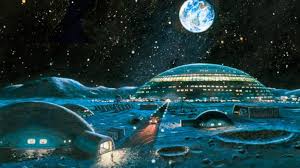
One lava tube has a sinkhole that is almost perfectly circular. Imagine that portion of the lava tube used for a colony or Moon base. Silica is converted to glass to completely cover this sinkhole with a glass dome or ceiling. The whole thing is converted to a giant greenhouse/ hydroponics garden. Food could then be grown on a scale making export feasible. The water would also be sold to spacecraft making the Mars/Earth trip cycle and to space habitats near the Lagrange points of the Moon. Exporting all that food and water would make the Moon the Safeway of the Solar System.

Fig. 8 Lunar garden dome; the tourist section 
next to the Lunar Hilton.

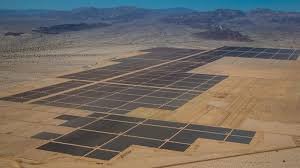
Power! People are not going to complain about that solar panel farm in their back yard on the Moon. There is a lot of space to soak up the Sun's rays and they aren't weakened by atmosphere. Photovoltaic panels will absorb about 20 percent more energy because of this. Silicon, the main ingredient in most solar panels, is the second most prevalent element in the Moon's crust, oxygen being the first. The panels can be made right there on the Moon. Now you can make virtually as much power as you need to do anything you want and have enough left over to sell by microwaving it to spacecraft, satellites, and space habitats that may need it. This makes the Moon, you guessed it, the Consolidated Edison of the Solar System.

Fig. 9 This would be a small solar panel installation on the Moon.

We've only been talking about physical stuff. There are other sources of treasure on the Moon. Tourism is one. A lot of wealthy people would be willing to plunk down good money to come to the Moon and stay at the Lunar Hilton. Besides going to the greenhouse dome, strapping on wings and flying (break a plant, you buy it), they could take trips to see where man first set foot on the Moon. Don't forget to buy that little souvenir cube of lunar rock before you go home. Doomsday preppers might consider it the ultimate survival bunker. People that find it hard to move around would go there for the burden lifted from their bodies. Military high ground is another. That aspect is worth a lot to governments. No major nation is going to let another nation claim the Moon for themselves for this reason. That is why there is likely to be international cooperation just so everyone can keep an eye on everyone else. Science is another. What a great place for giant telescopes. The low gravity and vacuum will be a natural laboratory for many experiments.

Fig. 10 The Lunar Hilton

These are the reasons we will live on the Moon. These are the reasons we should be tripping over ourselves getting back to the Moon. Men with vision and resources like Elon Musk, Sir Charles Branson, and Jeff Bezos should lead the charge in an obvious next step in our conquest of space and guaranteeing the continuity of the human race. Governments should realize the validity of these ideas, these realities, and make it easier by participating in the finance and technology of such an endeavor. To the Moon!

Fig. 11 The Moon.

May you be inspired.

Glen Hendrix

Other articles you may enjoy:


Thursday, January 31, 2013

The Zombification of Innovation?

by Glen Hendrix

We are clever. I'll grant us that. If you don't' think so, look at this coverage of technical exploits from 2012.

Yet some people complain about the pace of innovation, saying we've reached a plateau and there's not much new under the sun. They are wrong, but it's not their fault. They just can't help themselves. Don't blame lead in the water or genetically modified food or too much television. 

True, it's not a target-rich environment for innovation anymore. The days of Marconi, Edison and Tesla are gone. We know about the electromagnetic spectrum and we've seen the light on nuclear forces. We get telephony morphed into cellular communications. We're nano knowledgeable now. We can turn explosions into torque, grow babies from scratch and see the far reaches of the universe.

One could argue that now it is simply a matter of finesse. Cell phones were a done deal. It took someone like Steve Jobs to do it with such verve and panache that it transformed society. Rockets? Hahahaha! So old school. So why did it take Elon Musk to teach NASA how to get into space for less than $500 per pound.

Electric cars were the future until Ford came along. Once again, kudos to Mr. Musk for taking a mundane form of transportation that's been around over a century and turning it into Motor Trend's 2013 Car of the Year. He's just biding his time with steam cars.

We've mastered the production and distribution of electricity. We posses the miracle of antibiotics, have indoor plumbing, enjoy the magic carpets of airplanes and cars, can talk to anyone on the planet or instantly access the knowledge of the world: What is there left to do? Our productivity per person over the past 200 years has climbed from nearly zero to peak at 3% in the middle of the last century. It has now fallen to 1.33% despite now having a car that drives itself and computers that we can have conversations with. Why can't we invent something to get things going again instead of just tweaking what we've got? It's an illusion.


Kroger has agreed to give you free trash bags for life if you buy this.


The reason it seems innovation has stagnated is because the torrid pace of innovation for the last 150 years has set a standard that will never be seen again. It is simply by comparison that we think innovation has flatlined. Mankind has come from animal-fat torches to electric lights in the blink of an eye, historically speaking. We are immersed in it. We can't step outside and look back in objectively at the timeline and say, "My that WAS quick." We have been inoculated against perceiving innovation. That's why when I tell you there is a now a company that can do 3D printing of solid stainless steel, you go "meh." 

We are only being less innovative compared to a blistering pace that can never be matched again unless there occurs some sort of singularity moment. Yes, there are exciting advances being made in 3D printing, driverless vehicles, and gesture-based computing; but we are losing sight of what is really important. Despite the fact that innovation is alive and well, there is a void that has left us lacking. There are three critical technology goals that need to be addressed to get past this period of "stagnation" and provide mankind a comfortable, safe, productive future: vast amounts of cheap energy, inexpensive access to space, and lengthening the human lifespan. One of these three turns out to be yet another reason we think our collective cogency has been compromised.

ENERGY:

It's energy. Energy is the choke point, the stricture, the bottle ne...you get the idea. Except for steampunk, energy technology and its implementation has been woefully inadequate to keep up with current and future demands. Quoting from the bigthink article Bits Versus Stuff: Peter Thiel Asks Why Has Innovation Stalled "'we're no longer moving faster,' literally. And part of the reason we don't have things like supersonic commercial jet planes, he says, 'is due to the failure of energy innovation.'" He made this remark at a festival of ideas, The Nantucket Project held in October of 2012, after stating that pessimism has "started to seep into our system." Peter hasn't snapped to the "pessimism"  actually being a society-wide perceptual problem but, hopefully, people will listen to him because energy is a problem that needs to be addressed. Remember the Concorde!
All of our technologies depend on energy. Transportation, data processing, manufacturing, heating and cooling; you would be hard-pressed to come up with something that doesn't use energy. Even pressing the button on that remote takes energy. Our lifestyles are a reflection of that energy availability and cost. We can look at the gas pump and see that things aren't like they used to be. Three dollar gas in the U.S. is a symptom of the beginning of, dare I say it, peak oil. Calm down. It's here. Gotta deal with it. Even with less driving and more efficient cars, we will soon max out on what can be economically extracted. This will become a serious buzzkill for the global economy. 

Convenience and low cost of fossil fuels have driven our economy up to now. They are so part and parcel that talk of cutting back or replacing them is an invitation for rabid and irrational response. This is despite the increasing awareness that they are intrinsically connected to climate change. We don't just need research here. We need the fossil fuel industry to get on board with going renewable.

The first solar cell was made in 1883. There's enough U-238 for breeder reactors to last 5 billion years. Solar energy hitting the Earth is 20,000 times what humanity currently uses. But we are still building coal plants and still don't have nuclear fusion! The largest solar energy projects in the world are being built in Saudi Arabia. What does that tell you, Exxon? We need cheap, pollution-free energy and lots of it. I hear thinking caps being drug out of cardboard boxes in the attic and dusted off…aaaahchooo. It's a good thing. I'll take some Benadryl. Another recent miracle? 1943.

SPACE: 

Yes, there may be 20,000 times the energy currently needed hitting the Earth in the form of sunshine but, believe it or not, we'll outgrow that, as well we should. Are you going to put some limit on our future growth? I thought not. It's all out there. A whole star's worth of sunshine for energy, hydrocarbons for plastic, and water for…well, it's pretty handy. Space = future.

But there is a darker reason we need to get into space. 

The first human broadcasts that  made it into space were Hitler's broadcast of the 1936 Olympics 77 years ago. We are at the center of a 144 light year diameter bubble filled with our electromagnetic babble. There are less than 500 "G" type stars, those similar to our sun, within this sphere. Chances are slim for E.T. to be on one of them. But as time goes on, that boundary expands. The reason we should be concerned about "others" is what we are capable of doing ourselves, and most of us have never thought of it.


If this had been around 15 years ago, the “paper or plastic” question would be pretty moot.  


We now have the capability, with off-the-shelf technology, to destroy a planet in another planetary system light years away with relativistic missiles. No, I am not writing this from a padded cell. Combine several NASA HiPEP ion thrusters with a TOPAZ style nuclear reactor, a computer, and a few tons of xenon (all properly armored against cosmic radiation); and you have a weapon that travels for light years and arrives at an appreciable fraction of the speed of light. The Death Star would be envious of this weapon's kinetic punch. What it doesn't destroy, it buries in meters of ash. I've done the math. Hint: force = acceleration x mass; velocity = acceleration x time.

Image of Defense Department employee's id.

Image courtesy of DannoGerbil @ deviantArt.com
What does that have to do with humans in space? Well, let me ask another question. How paranoid do you think our defense department really is? Yeah, me too. Maybe I'm projecting, but it wouldn't be a stretch to think some Romulan/Borg type race might come up with this type of weapon as well. The question of whether or not we push into space permanently is like the climate change question. Maybe it is a coincidence that carbon dioxide levels started to spike with the advent of the industrial age and maybe not. If we ignore it and it was a coincidence, we continue our merry existence. If we ignore it and it wasn't a coincidence, we've made a grave error - perhaps fatal. Hopefully, you won't have to make excuses to your grandchildren about your F-650 pickup truck.


Use those plastic grocery bags again. Save money. Save the world. Here’s how. 


The human race, as we physically look now, has been around about 100,000 years. In another 100,000 years "I Love Lucy" will be galaxy-wide. The cat's out of the bag. The can of worm's has been opened. There's cat fur covered worms crawling everywhere and we cannot clean that mess up. If we are going to last another 100,000 years, I suggest we get into space. We will develop new technologies and will not have all our eggs in one basket. Am I preaching to the choir? Sheesh, I'm all out of cliches. Alien kinetic bomb sound far-fetched? Then substitute your favorite disaster: asteroid strike, super volcano, antibiotic-resistant plague, resource wars, kudzu, irradiation by cosmic rays, or settling philosophical differences with nuclear weapons.

Obviously, I'm not talking about a trip to Mars and back. I'm talking about permanent digs. That means an even cheaper means of space travel than what Elon has in mind. Something on the order of a space elevator. Not only would that make space inexpensive, it would provide a stable focus point (the counterbalance in geostationary orbit) and conduit to move power from collectors in orbit down to Earth. Mass goes up, power comes down. More how-to about living in space in a later post.

HUMAN LIFESPAN: 

Come on, admit it. If you thought you'd be around for another few hundred years, you'd pay a little more focused attention to what's happening to the environment and your 401k, wouldn't you? Not to mention take a little better care of yourself. That is exactly why research into extending human life is so important. This quarter by quarter planning has to change. Three months does not a future make. If it's not abstract, if we have a physical stake in the future, we will make sure the future is a better place. If you live to 300, who are you shortchanging if you harm the environment or waste precious resources? Uh huh.


 Paper or plastic? … If you said “paper”, read this.   


Average life expectancy in the U.S. has gone from 47 in 1900 to 78 today. Dramatic, but it is not enough. Science needs to find out why Methuselah could live 969 years and most of us now barely make it to 80. Of course it could be just a Biblical accounting error, but it is still a worthy goal. Long-term planning would become a necessity, a living art form. Profligation would be an aberration rather than a norm. People could have true multiple careers, becoming masters of many areas of expertise - Da Vincis by design rather than accident. Our descendants will ignore prescribed boundaries of erudition, cross-pollinating knowledge bases and multiplying our wisdom in ways we've never dreamed of.

They will do it after they are retired from their 9th career at 637 while jetting around the Solar System planning an "intervention" of the aliens that tried to exterminate us in the year 2432 A.D. with a relativistic kinetic missile.

Other articles you may enjoy: