Showing posts with label solar panels. Show all posts

Tuesday, July 31, 2018

Energy and Space; Tweedle Dee and Tweedle Dum


courtesy NASA

by Glen Hendrix

There is a substantial cadre of people and organizations that are very interested in the space industry. The whole industry is currently worth about $350 billion dollars, but Bank of America predicts 30 years will see an increase to nearly $3 trillion dollars.

While mostly concerned with Earth-orbiting satellites, a small portion of the industry is seriously considering the mining of asteroids on the assumption of a tremendous payback from the presence of metals and minerals in these floating mountains. 

NASA has missions scheduled in 2021 and 2023 to explore 16 Psyche, an asteroid that contains a lot of resources. It is a 130 mile diameter nickel and iron asteroid thought to once be part of the core of a planet.

The material of this asteroid is similar to that at the center of the Earth, mostly iron with some nickel and traces of other metals. It’s the other metals I would be interested in, but the iron alone is, according to the article, worth $10,000 quadrillion. 

Let’s think about that. If you did manage to bring this space mountain into  Earth orbit, nobody on Earth would buy a pound of it. It is iron, but it still needs to be melted down and turned into useable shapes, so it is essentially high grade ore. Iron ore is going for $70 per ton but this has been pre-smelted by the fiery center of a now-defunct planet so let’s give it a round figure of $100 per ton. 

Plastic grocery bags prefer this as their second career. 


There is about 1,150,000 cubic miles of iron. A cubic mile of iron weighs about 36 billion tons and is worth $3.6 trillion dollars. So the whole caboodle is worth only $4,000 quadrillion, not $10,000 quadrillion. Hah! Caught ya! Who cares. It’s a lot. 

When you go to sell it, though, no one on Earth wants it. It currently costs $10,000 dollars per pound to get something into orbit and, therefore, $10,000 per pound to get something back to Earth. Your ton of high grade ore jumped to $20,000,100 per ton on the open market because of transportation cost. Buyers on Earth would rather pay the $70 per ton. I don’t blame them. You grifter! 

There are only two options; sell it to someone that is going to use it for construction in space or figure out a cheaper means for getting it down to the Earth’s surface. Discussion of the latter will be the subject of another article.

No one is building enormous structures in orbit … yet. Your asteroid is like that 1000 acres the family owns outside of Phoenix. You know that someday it will be worth a lot when developers are ready for it. You need money now, though, to pay the bills. It doesn’t help that it cost nearly half a trillion dollars to get it back to Earth and it is really your great grandchildren who will reap the benefits because it would take so long to move that much mass. 

To give you a financial break let’s say the asteroid is not 16 Psych but 162173 Ryugu. This is a rock that comes within 6,000,000 miles of Earth (very close) in December of 2020. It is a more manageable size (1km diameter) and contains not just nickel and iron but cobalt, water, nitrogen, hydrogen, and ammonia as well. Here is a great site for picking out your asteroid. That’s where I found 16217 Ryugu. 

A Falcon Heavy delivers your 30,000 pound asteroid retrieval robot spaceship named More In That Vein from Cape Canaveral into a high Earth orbit. More In That Vein unfolds its solar arrays and begins the electrolysis of water, burning the hydrogen and oxygen in thrusters. 

It arrives at Ryugu six months later. The apparent rotational velocity of the surface of the asteroid is only one quarter mile per hour, no problem for the agile More In That Vein to match up to. The spaceship’s interface adaptor frame comes into contact with the surface at a pre-screened, structurally sound spot and sixteen explosive bolts penetrate the surface and expand slightly to provide a solid connection between the ship and the asteroid. 

Saving the world one plastic bag at a time. Recycling genius.  


Robotic crawlers explore the asteroid for water and methane. Finding a major deposit of ice, it mines this to top the tanks off for the trip home and sets up an automated refill schedule. Meanwhile, More In That Vein has de-spun the asteroid to zero rotation and plotted the quickest journey back to Earth orbit. Its swivel-mounted engine swings to the calculated coordinates and fires up gently so as not to disturb some slight structural faults uncovered by prospector bots and heads back to Earth with its treasure. 

The artificial intelligence of More In That Vein constantly adjusts the course of the asteroid, micromanaging it into place at the L5 Lagrange point of the Earth-Moon gravitational system. This is a stable point 239,000 miles from both the Earth and the Moon.

Yeah! But you still can’t sell anything. It is too expensive … wait … my phone. Let me get this. It’s for you. The Chinese want one million tons of shaped steel for a facility orbiting the Moon and a ten year option on three more million. Lucky you. Someone on Earth has just announced a breakthrough in fusion technology making it commercially feasible. The Chinese are going to build a Moon base and space elevator to extract hydrogen-3 (tritium) from the Moon’s surface and sell it on Earth to make those new fusion reactors purr like kittens. 

courtesy NASA

Obviously, no one is going to retrieve an asteroid on speculation. The initial investment is too much to leave to chance. There will be a lot of wheeling and dealing. If you hear of a robot asteroid miner being launched you will soon hear of a major orbital space project being planned for the Earth or the Moon.

Energy and asteroid mining are intertwined. Whether its mining the Moon for hydrogen-3; or building giant mirrors to gather solar energy, convert it to microwaves, and send it back to Earth; or finding water to split into hydrogen and oxygen to burn for rocket fuel; the basic economic reason we will go into space will be for energy. There is simply so much of it, and it is so cheap there will be no way for the uber rich to funnel all of that energy wealth into their pockets. Their pants would catch on fire. Energy needs to be available in vast, non-polluting, inexpensive quantities for the lifestyles we are accustomed to on this fine blue marble to be maintained without detriment to the environment. The resources we extract from asteroids are an important part of that equation. 

Other articles you may enjoy:


Saturday, November 25, 2017

We Will Live on the Moon: the How and Why

There has been some interest on the internet lately about lava tubes on the Moon. These have been known about for some years, but there hasn't been enough said about what this means to us as a supposedly intelligent race of beings on the cusp of becoming a spacefaring civilization. It brings a focus on the Moon as a candidate for a jumping-off station to the rest of the Solar System and beyond.


For the cost of 4 macchiatos you can have plastic trash bags for life.


Two separate studies of the Moon have identified ideal places for a lunar colony. In 2011, NASA's Gravity Recovery and Interior Laboratory, also known as GRAIL, consisting of two spacecraft, Ebb and Flow, mapped the gravitational field of the Moon in great detail. In 2007, the Japanese space agency, JAXA, used the spacecraft Kaguya, to map the Moon from orbit using a magnetometer, radar, and imaging instruments.

Fig. 1 
The Ebb and Flow spacecraft from the
NASA project GRAIL

Fig. 2 
Kayuga spacecraft from the Japanese
space agency JAXA

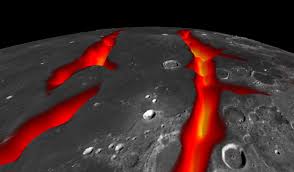
What they discovered was the presence of ancient lava tubes beneath the surface of the Moon. Thirty miles long; 340 feet wide; and, by some accounts, 3000 feet tall. There may be many such underground caverns on the moon.

Fig. 3 Artist's interpretation of the active
volcanism that create lava tubes and
pit craters or sinkholes.

Fig. 4 Pit holes or sinkholes are collapsed roofs
of lava tubes. About two hundred have
been found on the Moon.

Fig. 5 String of pits
following a lava tube.

Besides being excellent candidates for collection sites of lunar ice, these would provide protection from the -298 to +224 degrees Fahrenheit swings of temperature found on the surface of the Moon. Protection from radiation is another important consideration. We take it for granted, but the Earth with its electromagnetic force field and atmosphere protects us from ionizing radiation coming from the depths of space. Cosmic rays are strong enough to rip apart atoms in human genetic material, making cancer and mutations much more likely. Radiation storms from solar flares can cause so much damage to unprotected human tissue that sickness or death are very likely. Radiation can also play havoc with electronics that are not properly protected: thus, the protracted angst concerning the possibility of a nuclear weapon in orbit that, if exploded there, could take out a continent-sized swath of Gameboys and iPhones. Civilization would be doomed.

Fig. 6 Illustration of the formation of a lava tube on the Moon.

It takes 4" of lead, 10" of steel, 24" of concrete, or 36" of packed dirt to properly shield humans from radiation. Now you get an inkling of how difficult the trip to Mars in a space ship is going to be. Can you imagine the fuel required to move a spaceship made of 10" steel plate? Of course, it will just be a small emergency room lined with special radiation absorbing plastic, but it is still extra weight. So, to find a radiation shelter ready-made on the Moon is amazingly wonderful news. The perfect hideaway for a lunar colony. But why? I mean why a colony on the Moon?

Plastic grocery bags prefer this as their second career.


Mankind is at a dangerous juncture. There is a real threat of the planet running low on critical resources. Climate change may be worse than we think. A super volcano could erupt. An asteroid could strike. A super-flu virus 3 times worse than the 1918 flu pandemic could decimate humankind. Therefore, we need a permanent, self-reliant human presence in space to carry on should any of these things take mankind back to neolithic levels of technology.

But impending doom is apparently not a good impetus for the human race to do anything. Even with all that stuff going on, a lunar colony is not going to happen if there is not money or its equivalent in the game. Good old greed is what we need to set the wheels in motion for a colony on the Moon. So, what is on the Moon that is worth us going back to it, sprucing up one of these lava tubes, and sitting around the metaphorical campfire in the cave feeling smug about finally being in space on a permanent basis?

Great way to carry your groceries; + trash, dirty clothes, food prep waste, garden clippings, etc.


As everyone knows, nuclear fusion will be a reality in 20 years. Ahahahahahaha! No, really. It could be. It's very close now. Helium-3 can make nuclear fusion much more efficient and eliminate nuclear waste and radiation. Several governments have plans to mine the Moon for helium-3 to facilitate nuclear fusion. Based on how much energy it would produce, it is worth about $3 billion dollars per metric ton. There is an estimated 1,100,000 metric tons trapped in lunar soil. That is $3,300,000,000,000,000. It would have to be cooked out of the regolith at 1100 degrees Fahrenheit, so the lava tube would make an excellent location for a helium-3 processing plant.

Fig. 7 Inside the Alcator C-mod tokamak 
used in nuclear fusion research.

Other elements in relative abundance are oxygen, aluminum, calcium, titanium, silica, and iron. You might think these would not be for export (except, maybe, the titanium and the oxygen), and that they would mainly go toward helping build the lunar colony. They would, but think of the possibilities. Titanium, aluminum, and iron (used to make high-grade steel) in combination with 3D printers that print with even high-temperature metal will make the Moon the Home Depot of the Solar System. Spacecraft and space habitat parts will be designed on Earth. These files will be sent to the  Moon where they will be printed out. From the Moon they will be lifted into orbit for much less than the same parts coming from Earth. Not only is there one sixth the gravity, the rocket taking it into orbit will be magnitudes cheaper because it can ignore streamlining and thermal insulation. A surface to orbit moon lifter would be an ungainly looking device, mostly metal frames encircling the cargo pod with rocket motors attached to that frame.

High temperature ceramic parts can also be made from material on the Moon. These are critical for some space applications. The lunar crust is about 40 percent oxygen so there will be no shortage of that for breathing or burning.

There might be a future for powdered aluminum as rocket fuel as well. This, in combination with the obvious oxygen, and the Moon becomes the Exxon Mobil of the Solar System.

Water! Six hundred million metric tons of water at the north pole of the Moon. Similar conditions (perpetual darkness) exist at the south pole, so there could be twice that much. Drinking, bathing, and hydroponics would be the main human uses. It would still be considered an extremely valuable resource and recycled over and over ad infinitum a la Dune. The other uses would be industrial; perhaps as a coolant for machining metal parts but certainly for splitting into oxygen and hydrogen for their usefulness in industrial and chemical processes. The hydrogen would be more important since there is plenty of oxygen in the lunar regolith. 

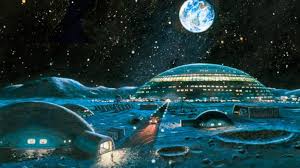
One lava tube has a sinkhole that is almost perfectly circular. Imagine that portion of the lava tube used for a colony or Moon base. Silica is converted to glass to completely cover this sinkhole with a glass dome or ceiling. The whole thing is converted to a giant greenhouse/ hydroponics garden. Food could then be grown on a scale making export feasible. The water would also be sold to spacecraft making the Mars/Earth trip cycle and to space habitats near the Lagrange points of the Moon. Exporting all that food and water would make the Moon the Safeway of the Solar System.

Fig. 8 Lunar garden dome; the tourist section 
next to the Lunar Hilton.

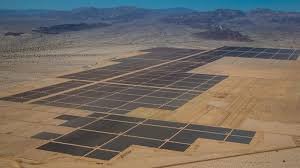
Power! People are not going to complain about that solar panel farm in their back yard on the Moon. There is a lot of space to soak up the Sun's rays and they aren't weakened by atmosphere. Photovoltaic panels will absorb about 20 percent more energy because of this. Silicon, the main ingredient in most solar panels, is the second most prevalent element in the Moon's crust, oxygen being the first. The panels can be made right there on the Moon. Now you can make virtually as much power as you need to do anything you want and have enough left over to sell by microwaving it to spacecraft, satellites, and space habitats that may need it. This makes the Moon, you guessed it, the Consolidated Edison of the Solar System.

Fig. 9 This would be a small solar panel installation on the Moon.

We've only been talking about physical stuff. There are other sources of treasure on the Moon. Tourism is one. A lot of wealthy people would be willing to plunk down good money to come to the Moon and stay at the Lunar Hilton. Besides going to the greenhouse dome, strapping on wings and flying (break a plant, you buy it), they could take trips to see where man first set foot on the Moon. Don't forget to buy that little souvenir cube of lunar rock before you go home. Doomsday preppers might consider it the ultimate survival bunker. People that find it hard to move around would go there for the burden lifted from their bodies. Military high ground is another. That aspect is worth a lot to governments. No major nation is going to let another nation claim the Moon for themselves for this reason. That is why there is likely to be international cooperation just so everyone can keep an eye on everyone else. Science is another. What a great place for giant telescopes. The low gravity and vacuum will be a natural laboratory for many experiments.

Fig. 10 The Lunar Hilton

These are the reasons we will live on the Moon. These are the reasons we should be tripping over ourselves getting back to the Moon. Men with vision and resources like Elon Musk, Sir Charles Branson, and Jeff Bezos should lead the charge in an obvious next step in our conquest of space and guaranteeing the continuity of the human race. Governments should realize the validity of these ideas, these realities, and make it easier by participating in the finance and technology of such an endeavor. To the Moon!

Fig. 11 The Moon.

May you be inspired.

Glen Hendrix

Other articles you may enjoy: